-
 Welcome to plumtriA platform for Research & Innovation
 -
 Looking for Funding?Check out the current open calls
 -
 Register today to start receiving our monthly newsletter
 -
 Looking to partner up?Search our list of registered profiles
 -
 You have questions on a particular funding programme?

Listening to the Motor Without Asking Where the Rotor Is
Image
Author: Christian Keszthely
Modern alternating-current motors have an awkward dependency: the drive control system must always know the rotor's position. That tiny fact – a position, measured again and again – decides whether a car glides off the line or shudders, whether a crane holds steady or lurches. It matters far more than it sounds n electric cars, trains, cranes, and aircraft, the rotor inside the motor has to stay in sync with the electrical currents that power it. If the timing is off, the motor can stutter, shake, or stop working. To prevent this,
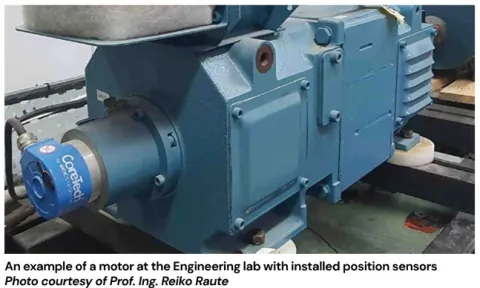
most modern electric motor drive systems use position sensors. ‘It is a very important device. But it is also the weak link,’ says Prof. Ing. Reiko Raute, Associate Professor of Electrical Engineering at the University of Malta and Principal Investigator for the project ‘Permanent Magnet Synchronous Motor Design for Position Sensorless Drives (SensorlessPMSM)’. Position sensors report the rotor’s location to the controller thousands of times per second. They help motors run smoothly and reliably, but they also add cost and complexity, and make the system more fragile. ‘In a small motor, sometimes the motor itself is cheaper than the sensor,’ Raute explains. ‘And when something breaks, it is often the sensor that breaks first.’ Raute’s research asks a simple question: Can we design a motor that does not need a sensor, since we can figure out its position from its behaviour?
WHY MOTORS NEED TO ‘KNOW THEMSELVES’
Think of pushing someone on a swing while blindfolded. If you cannot tell where the swing is, you might push at the wrong time or in the wrong direction. The swing slows down or moves unpredictably. Electric motors face a similar challenge. Modern motors – especially permanent magnet synchronous motors (PMSMs) used in electric vehicles – run on carefully timed alternating currents. These currents must always align with the position of the rotor’s magnets. ‘The phase of the voltage we apply is always aligned with the magnets,’ Raute says. ‘Otherwise, the motor will not work very well.’ This alignment is not optional. It happens continuously, often more than 2,000 times per second. The controller reads the rotor’s position, calculates the correct current, applies
it and repeats – over and over again. That’s the job of position sensors. They work like a GPS for the motor, always reporting the rotor’s location. But what if we could read the rotor’s position another way?
THE COST OF KNOWING TOO MUCH
Position sensors are precise, but like any mechanical part, they wear out and can fail over time. ‘They are fine mechanical systems with small cables,’ Raute explains. ‘They can break more easily than the motor itself.’ A sensor might cost a car maker
about €50, but replacing it can cost the owner hundreds. Across millions of cars, this becomes a big expense. In safety-critical systems – like electric aircraft or high-speed trains – the stakes are even higher. ‘They often use double encoders,’ Raute notes, ‘because this is a functional safety device.’ More parts mean more potential points of failure. More wiring adds weight. More maintenance leads to more downtime. If we could remove the sensor and still have reliable control, it would represent a substantial shift.
THE PROMISE – AND LIMITS – OF SENSORLESS CONTROL
Engineers know that motors emit useful signals as they run. When a motor spins, it creates voltages and currents that indicate what is happening inside. At medium and high speeds, these signals are clear, and back-EMF methods are common. Back-EMF is the small voltage a spinning motor generates in opposition to the power driving it – effectively, it is the motor talking back to its controller. ‘When the motor rotates fast enough, this problem is solved,’ Raute says. ‘You can buy many motor controllers with sensorless control.’ The problem arises at low speeds, especially when the motor is stopped. At zero speed, there’s no back-EMF, since it only appears when the motor is turning. But this is when control matters most – like starting a car on a hill, moving aircraft wing flaps, or lifting with a crane. At low speeds, engineers look at another signal: inductance.
READING THE MOTOR’S FINGERPRINTS
Inductance changes as the rotor moves because of the motor’s shape and materials. Steel, magnets, and air all affect the magnetic fields inside. In theory, these changes can be measured, and the rotor’s position estimated, even when it is not moving. But in practice, every motor is different, and the signal is complex ‘The signal that you see is sometimes very weird and difficult to understand,’ he explains. ‘And this signal depends on the motor design.’ For years, researchers have tried to build better algorithms to read these signals. Raute worked on this during his Ph.D. research more than 20 years ago. ‘We put intelligence into the inverter,’ he says. ‘We could see clear signals, but sometimes they did not make sense.’ Over time, it seemed the issue might not be with the algorithms, but with the signals from the motor itself.
TURNING THE PROBLEM INSIDE OUT
Most research tries to get better information from existing motors. Raute’s team asks a different question: what if we designed the motor to give clearer signals? ‘Up to now, people always worked with off-the-shelf motors,’ he explains. ‘But most motors give very weird signals at some point.’ Modern simulation tools make this possible. Using finite-element software, Raute’s team builds detailed virtual motors, including the steel, magnets, and windings, and studies their behaviour. ‘Fifty years ago, this was not really
possible,’ he says. ‘Now we can really see how the motor behaves.’ The simulations show that even small changes in magnet
placement, shape or steel geometry can make the inductance signal much clearer – or much more erratic. ‘It may be very simple to arrange the magnets a little bit differently,’ Raute says, ‘so that sensorless control works much better at very low speeds.’
A NEEDLE IN A MAGNETIC HAYSTACK
Designing motors is already a trade-off. Engineers have to balance efficiency, size, torque, cost and material availability. Rare-earth magnets are strong, but they are expensive and difficult to source. These are permanent magnets manufactured from alloys of rare-earth elements – primarily neodymium (NdFeB) or samarium-cobalt (SmCo) – which belong to the lanthanide series
of the periodic table and enable exceptionally high magnetic energy density relative to their size. ‘Manufacturers try to get the
highest efficiency, the smallest size, and maybe even get rid of some permanent magnet material,’ Raute explains. Making the motor easier to read without sensors adds another challenge. ‘There are endless possibilities,’ he says. ‘The size, the shape, and the location of the magnets – they change everything.’ Right now, the research is a mix of science and trial-and-error. ‘We are still a bit in a trial-and-error phase,’ Raute admits. ‘We try many different designs and see what effect they have.’ The team examines factors such as current effects, magnetic saturation, and steel geometry, and studies how they interact. Artificial intelligence may help search through all these design options in the future. But first, the fundamentals need to be understood. ‘AI needs to be rained on something,’ Raute notes. ‘And no one has done this before.’
WHY ZERO SPEED MATTERS
Most people do not think about zero-speed control until something goes wrong. ‘A motor usually starts from zero speed,’ Raute says. ‘And in this state, you want to know the rotor position very well.’ If the controller does not know the rotor’s position, it might send the wrong current. The motor can jerk, shake or act unpredictably. That is why cars use encoders to sense position. ‘As soon as you turn on the electronics, it knows where the rotor is,’ Raute explains. If sensorless control worked well at zero speed, many systems could be simpler. Cranes and lifts could hold loads more safely. Aircraft could use lighter electric systems instead of hydraulics on wing flaps. ‘The piping system of hydraulics is very heavy,’ Raute says. ‘The cables of a motor are lighter.’
FEWER PARTS, FEWER FAILURES
Reliability might be even more important than cost savings. ‘Motors themselves are very strong,’ Raute says. ‘Big copper windings, big bearings.’ But sensors are fragile. ‘If you can remove the encoder,’ he explains, ‘you reduce maintenance, space and failure points.’ And because PMSMs are already the preferred choice for electric vehicles and aircraft – thanks to their efficiency and power-to-weight ratio – improving their robustness has an outsized impact. ‘If you have some intellectual property on how to design the motor cleverly,’ Raute says, ‘this would be worth a lot of money.’
WHERE THE RESEARCH STANDS
The project is still in progress, and the research team continues to move at a steady pace. ‘We hope at least to have a good software model by the end of April,’ Raute says. A hardware prototype might come later, but simulations are not perfect yet. Still, the goal is clear. Instead of making algorithms work harder to read noisy signals, the team wants to redesign the motor to produce a
cleaner signal. As Raute says: ‘We try to design a motor that gives us a clean signal that we can really use.’ If motors can be designed to reveal their position through their own physics, one of electrification’s most persistent dependencies simply falls away.
Project ‘Permanent Magnet Synchronous Motor Design for Position Sensorless Drives (SensorlessPMSM)’ is financed by the Xjenza Malta for and on behalf of the Foundation for Science and Technology, through the FUSION: R&I Research Excellence Programme.
Information and image source:
Attachments: