-
 Welcome to plumtriA platform for Research & Innovation
 -
 Looking for Funding?Check out the current open calls
 -
 Register today to start receiving our monthly newsletter
 -
 Looking to partner up?Search our list of registered profiles
 -
 You have questions on a particular funding programme?

University of Malta Successfully Concludes HESS Project: Advancing Green Energy for Sustainable Transport
Image
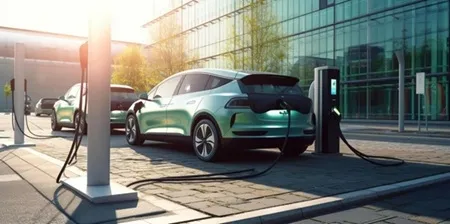
The University of Malta has successfully concluded the Hybrid Energy Storage System (HESS) project which is a major initiative exploring how renewable energy and advanced storage can power cleaner transportation. Led by Prof. Ing. John Licari from the Department of Electrical Engineering, the project was supported through the SINO-MALTA Fund 2023 Call, strengthening scientific collaboration between Malta and the People’s Republic of China.
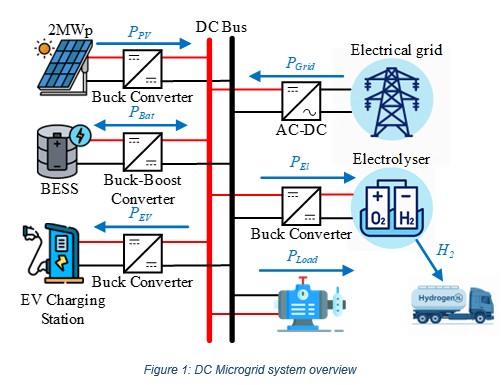
The research focused on how solar energy, batteries and green hydrogen can work together to electrify mobility while reducing strain on the electrical grid. The study involved the modelling and control of an Electro-Hydrogen HESS-based microgrid system to optimise energy management. A schematic block diagram of the microgrid system is presented in Figure 1. The microgrid integrates the PV generation, a battery energy storage system (BESS), and a PEM electrolyser, all interconnected via a 1.5 kV DC bus.
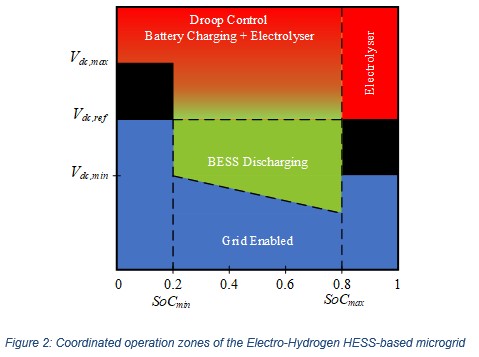
The proposed Hybrid Energy Storage System integrates rooftop solar photovoltaic generation, a BESS providing evening EV charging, a hydrogen electrolyser running on surplus solar energy and an energy management algorithm to coordinate all energy flows. Figure 2 illustrates the coordinated operation zones of the Electro-Hydrogen HESS-based microgrid.
Simulations based on real solar and industrial load data produced excellent outcomes and achieved all the following objectives:
Electric vehicle charging powered primarily by onsite solar
No grid power exported
Green hydrogen produced from excess energy
Stable and resilient operation under fluctuating conditions
The results obtained confirm the ability to support both electrified transport using and future hydrogen mobility using solar energy, BESS and electrolysers. In addition, this was achieved by making efficient use of renewable energy and without straining the electrical grid.
With the research phase successfully completed, the path for future work includes building a laboratory based system using hardware in the loop testing.
The HESS project brought together expertise from the University of Malta, including Prof. Inġ. John Licari who led the project, Prof. Alexander Micallef, Prof. Inġ. Maurice Apap and Dr. Salah Eddine Rhaili. The work described in this article was carried out as part of the HESS (SINO-MALTA-2023-03) project which was financed by XJENZA Malta and the Ministry for Science and Technology of the People’s Republic of China (MOST), through the SINO-MALTA Fund 2023 (Science and Technology Cooperation).
Information and images source:
🔗 HESS Project: https://www.um.edu.mt/projects/hess/
🔗 Department of Electrical Engineering: https://www.um.edu.mt/eng/ele/
🔗 Prof. Ing. John Licari: https://www.um.edu.mt/profile/johnlicari
Attachments: