-
 Welcome to plumtriA platform for Research & Innovation
 -
 Looking for Funding?Check out the current open calls
 -
 Register today to start receiving our monthly newsletter
 -
 Looking to partner up?Search our list of registered profiles
 -
 You have questions on a particular funding programme?

MCAST Showcases AI-Driven Ethics Training Prototype at DHBW AI Transfer Congress
Image
Montalto, M., Bonnici West, L., Scerri, D., Gatt, A., Deguara, D., Debono, D., Galea Vella, M., Theuma, L., Delicata, F. and Gauci, S.A.
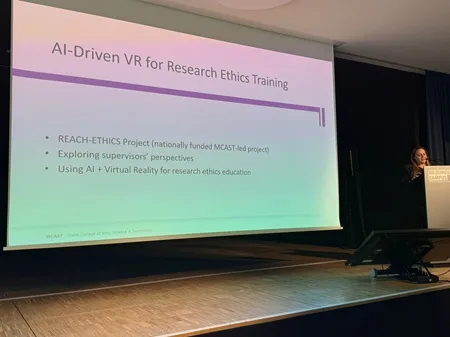
🛞 The REACH-ETHICS project, led by the Malta College of Arts, Science and Technology (MCAST), introduces an innovative approach to research ethics education through the integration of artificial intelligence (AI) and virtual reality (VR). The project aims to transform how students and researchers engage with ethical principles by moving beyond traditional, theory-heavy instruction toward immersive, scenario-based learning. The system employs AI-powered “expert” avatars within virtual environments to simulate real-life ethical dilemmas in healthcare and animal research contexts. Through interactive dialogue, users can explore key issues such as informed consent, confidentiality, and participant welfare in a more applied and reflective manner. This approach fosters active engagement, critical thinking, and experiential learning, thereby making ethics education more accessible, practical, and meaningful. Ultimately, the project seeks to enhance ethical awareness and decision-making while supporting educators through innovative teaching tools.
🔉 This work was presented by Dr Shirley Ann Gauci at the DHBW AI Transfer Congress on 24th April 2026 in Heilbronn, Germany, where the focus was on the evaluation of the AI-driven VR avatar prototype from the perspective of research supervisors. The study adopted a qualitative focus group design, complemented by quantitative evaluation. Supervisors from health and animal studies interacted with the avatar by posing ethics-related questions and assessing its responses across four key dimensions: relevance, correctness, completeness, and clarity.
🔬 Findings suggest that the REACH-ETHICS prototype has strong potential as a supplementary tool, rather than a replacement, for traditional research supervision and ethics teaching. Overall, the project, as presented at DHBW AI Transfer Congress, demonstrates the promise of combining AI and VR to create engaging, scalable, and pedagogically robust ethics training environments, contributing to the ongoing modernization of research ethics education.
💰 Project REACH-ETHICS is financed by Xjenza Malta through the FUSION: R&I Research Excellence Programme under grant agreement number REP-2024-006.
Attachments: