-
 Welcome to plumtriA platform for Research & Innovation
 -
 Looking for Funding?Check out the current open calls
 -
 Register today to start receiving our monthly newsletter
 -
 Looking to partner up?Search our list of registered profiles
 -
 You have questions on a particular funding programme?

Highlights from the workshop "Science to Policy: Appraising Concepts for the Marine Good Environmental Status"
Image
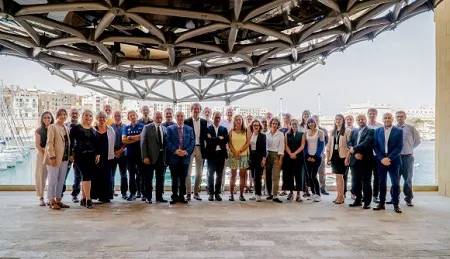
In November 2019, JPI Oceans launched the Joint Action “Science for Good Environmental Status (S4GES)”, to better understand marine ecosystems, how multiple activities impact the environment and how the requests of the MSFD can be fulfilled.
After eleven national institutions from the participating countries agreed to adopt an innovative approach for the assessment of GES, a first observational campaign on board of the RV Belgica was carried out in July 2022, as a UN Ocean Decade endorsed activity.
As data analysis from the campaign is now providing preliminary results, JPI Oceans’ S4GES organized a workshop in Malta on 21 and 22 June 2023, hosted by MCST, to debate the new results from different initiatives within the scientific community, to promote a salient knowledge-based support to policy, and to give new substance to interpretation of GES. Scientists from different initiatives of JPI Oceans and beyond, representatives from relevant authorities, regional conventions, the EU Commission and Parliament were be invited to join the workshop.
First day
On the first day, the scientists discussed the current state of scientific support for defining and evaluating Good Environmental Status. They also shared and discussed the insights gained from the JPI Oceans Joint Action #S4GES and explored various approaches and implications of scientific findings for implementing the MSFD.
The opening session was led by Aldo Drago from Malta Council For Science & Technology (MCST), along with Dr Tonio Portughese, the Chairman of MCST, and Hon. Keith Azzopardi Tanti, the Parliamentary Secretary for Youth, Research, and Innovation. Patrick Roose from Royal Belgian Institute of Natural Sciences in Belgium introduced the JPI Oceans S4GES Joint Action. This was followed by Federico Falcini from Consiglio Nazionale delle Ricerche in Italy, who presented the process-based approach for the S4GES campaign on RV Belgica. Nathalie Niquil from Centre national de la recherche scientifique in France, Luca Mirimin from Atlantic Technological University in Ireland, and Brendan McHugh from the Marine Institute in Ireland presented the state-of-the-art: trophic webs, e-DNA, and contaminants. Domenico D’Alelio from Stazione Zoologica Anton Dohrn in Italy, Isa Schön from RBINS in Belgium, Mario Sprovieri from CNR-ISMAR Institute of Marine Sciences in Italy, and Koen Parmentier from RBINS in Belgium discussed lessons learnt from the S4GES campaign on board of RV Belgica.
Second day
On the second day, scientists, policymakers, and practitioners discussed the progress of implementing the MSFD. They also reflected on the effectiveness of scientific support to policy in marine challenges, acknowledged the crucial role of the EU in addressing blue sustainability worldwide, and proposed future actions to efficiently and effectively fulfil the MSFD.
During the first session on the approach to complexity, Maltese stakeholders presented Malta's Monitoring Programme. This was followed by the presentation of Grazia Masciandaro from Consiglio Nazionale delle Ricerche in Italy, who shared information on the processes towards the EU Directive on soils. She also provided details on the latest soil policies and strategies, including the forthcoming Soil Health Law (#SHL) and the difficulties in defining Soil Health at the European level. Patrick Roose provided an update on the JPI Oceans S4GES Joint Action: testing complementary paths to simplify the complexity.
The second session opened with a presentation on the Belgian case, including the Marine Environment Act, providing for marine spatial planning in maritime areas under Belgian jurisdiction. The law forms the legal framework for conserving, restoring, and developing nature in the North Sea, which also protects from marine pollution. Furthermore, various provisions extend to Belgian vessels outside the Belgian part of the North Sea. The presentation was followed by the panel discussion on the MSFD with representatives from regional conventions and competent authorities, i.e. Dominic Pattinson (OSPAR), Rüdiger Strempel (HELCOM - Baltic Marine Environment Protection Commission), Erika Magaletti (IT Focal Point MEDPOL for the Barcelona Convention), Irina Makarenko (Black Sea Commission), and Angela Bartolo (ERA, MT). The view and the upcoming review of the MSFD were presented by the European Commission - DG ENV.
During the third session, Pier Francesco Moretti from Consiglio Nazionale delle Ricerche in Italy discussed multi-dimensional and multi-level systems contributing to marine chaos. Next on the agenda was a presentation by Eivind Lorentzen from Norwegian Ministry of Trade, Industry and Fisheries, who provided updates on the international scenarios and marine challenges. A panel discussion was conducted, primarily featuring insights from Early Career Scientists. This was followed by a discourse on operational advancements and suggestions prompted by inquiries from the Scientific Organising Committee of S4GES. The workshop concluded with closing remarks from Aldo Drago and Malta Council For Science & Technology Chairman Dr Tonio Portughese.