-
 Welcome to plumtriA platform for Research & Innovation
 -
 Looking for Funding?Check out the current open calls
 -
 Register today to start receiving our monthly newsletter
 -
 Looking to partner up?Search our list of registered profiles
 -
 You have questions on a particular funding programme?

Keeping Neuroscience Reliable. Building a Phantom Brain That Never Thinks But Always Knows
Image
Author: Andrea Cuschieri
Neuroscientists usually scan real brains to understand the mind. A team at the University of Malta is doing the opposite: they are building a fake brain first – not to think, but to keep neuroscience reliable. Their project, SARA, blends Functional Magnetic Resonance Imaging (fMRI) with delicate biochemistry in an unlikely marriage that could make brain imaging more reliable and more reproducible.
Functional Magnetic Resonance Imaging, better known as fMRI, is one of the most powerful tools modern neuroscience has ever created. It does not photograph neurons firing. Instead, it tracks changes in blood flow that occur when brain regions become active. When a cluster of neurons works harder, it consumes more oxygen. Fresh blood rushes in to replenish it, subtly altering the magnetic properties of that blood. The scanner detects these tiny shifts and transforms them into colourful maps that appear to show ‘thought in action’. Over the past two decades, fMRI has allowed researchers to peer into memory, emotion, decision-making, movement, and even creativity. Clinically, it holds promise for understanding conditions such as Alzheimer’s disease, epilepsy, and schizophrenia – all without a single incision. Yet behind its glossy images lies a much more complex reality.
WHEN BIG MACHINES GET IT WRONG
Like every scientific instrument, an fMRI scanner is imperfect. The signals it measures are weak, noisy, and heavily processed by complex software before scientists ever see them. What looks like brain activity is partly biology, partly physics, and partly statistics. Brains themselves make things even harder. No two are shaped the same, so researchers must warp each brain into a standard template by stretching and squeezing individual anatomy so that scans can be compared across people. That step is essential for research, but it also risks distorting the underlying data. The problem is not that fMRI is useless – far from it – but rather that it can be overtrusted. A bright blob on a brain image can look definitive even if it partly reflects scanner artefacts, software assumptions, or statistical quirks rather than true neural activity. As Dr Claude Bajada, the principal investigator of Project Synthetic Anatomy for Radiological Applications (SARA), explains, uncertainty is unavoidable: ‘Every analysis has noise… it is good practise to investigate what the noise is to validate how robust the analysis techniques are.’ This matters because if the technology is unreliable, the consequences could include misinterpretation of results or clinical trials built on unstable foundations. As Bajada bluntly put it: ‘If you get this wrong, you risk entering clinical trials on a foundation that doesn’t make sense, potentially wasting millions in funding.’ So, how do you test whether fMRI is producing accurate readings or not?
FLIPPING THE SCIENTIFIC METHOD ON ITS HEAD
This is where Project SARA takes a radical turn. Normally, scientists scan real brains and try to infer what is happening inside them. SARA does the opposite: it works to create a fake brain where the answer is already known, then tests whether the scanner and analysis pipeline can find it. Instead of asking, ‘What is the brain doing?’ SARA asks, ‘If we already know what should be there, do the fMRI and data processing algorithms detect it correctly?’ This provides what researchers call ground-truth data, a reference reality against which every measurement, algorithm, and assumption can be checked. As Bajada described it, this is essentially neuroscience in reverse: ‘You know what to expect… it is more about calibration – if you know what the outcome is meant to be.
Unlike a real brain, the SARA phantom will never think, but it will always generate exactly the signal that it was designed to pro-duce.
THE TEAM BEHIND THE SYNTHETIC BRAIN
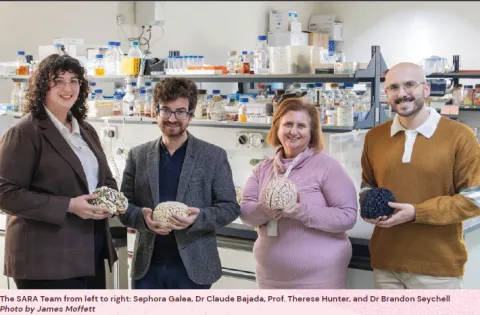
SARA is led by Dr Claude Bajada from UM’s Boundaries of the Brain (BOB) Lab, together with Prof. Therese Hunter from UM’s Biochemistry and Protein Science Lab. Dr Brandon Seychell and Sephora Galea contribute to the project through the physical construction of the phantom, experimental design, and data analysis. From the outset, the team faced two intertwined challenges: first, to make the phantom look like a real human brain; and second, to make it behave like one inside an MRI scanner. The shape matters enormously. Modern fMRI analysis depends on standardised brain templates, so a phantom that does not resemble real anatomy would be useless for testing real-world methods. As Bajada explains, ‘A lot of the analysis depends on preprocessing, and this needs to have the same shape of a brain to fit into the standard protocols.’
MIMICKING THE BRAIN: DEVELOPING HYDROGELBASED BRAIN PHANTOMS
Building a stable, detailed, brain like object that could survive inside a powerful MRI scanner required many rounds of optimisation, trial and error, and careful craftsmanship. The concept seems simple – to ensure that fMRI machines and associated data-processing algorithms are measuring what they intend to. Yet, as Hunter eloquently sums up, ‘The project started from a very simple place to create something that is not so simple for a very complicated and complex experiment.’ Such a complex undertaking requires creativity and an unlikely merger of two distinct disciplines on either end of the scientific spectrum. At first glance, fMRI neuroscience and biochemistry seem worlds apart – one deals with colossal magnets and radio waves, the other with delicate molecules and chemical reactions. Project SARA deliberately bridges this gap. The physical brain model is built from hydrogels, which are soft, water-rich materials that mimic the mechanical and magnetic properties of real brain tissue. These gels can be shaped to reproduce the brain’s intricate folds and differentiate between grey matter and white matter. But structure alone is not enough.
Most existing brain phantoms generate signals using simple electronics. The SARA team is trying something different by achieving
signals using biochemistry. They are experimenting with hemin, a molecule closely related to haemoglobin, the oxygen-carrying protein in red blood cells. By alternating hemin and saline solutions and exploring the magnetic changes in the presence and absence of hemin’s iron, the team aims to create controllable MRI signals that mimic changes of blood oxygenation in a living brain.
The goal is not to perfectly replicate human physiology, but to generate repeatable, predictable, brain-like signals that can be turned on and off at known locations inside the phantom. In a sense, SARA is a brain that rehearses activity without consciousness.
TOWARDS A BRAIN THAT ALREADY KNOWS THE ANSWER
One of the most powerful features of the SARA phantom is not just where the signal appears, but also how that signal switches on and off over time and whether analysis algorithms can correctly recognise that pattern. In human studies, many fMRI analyses are built around expectations. For example, during a task the brain should show a clear on–off–on–off pattern of activity that matches
the experimental design. Scientists then ask which parts of the brain follow that pattern. The problem is that this assumes both the scanner and the analysis are faithfully capturing what really happened. With SARA, that assumption is removed. The team can program a precise, known ‘on’ or ‘off’ signal into the phantom and then test whether the fMRI scanner and the analysis pipeline detect it as they should. This is especially important for newer, data-driven approaches such as resting-state fMRI, where people
lie still and researchers search for spontaneous patterns of connectivity. These methods are promising but difficult to validate because there is no obvious correct answer in a real brain. As Hunter emphasises, ‘You cannot assume anything is a real signal
– whether it is noted through an MRI or a huge DNA-sequencing machine.’ SARA therefore provides a controlled way to stress-test not just scanners, but the mathematical assumptions behind fMRI analysis itself, before those techniques are used to make big claims about how the human mind works.
FROM PHANTOM BRAIN TO REAL IMPACT
SARA is not meant to replace research on real brains; they will always be essential. Instead, the phantom acts as a quality-control
brain, a trusted benchmark that keeps the entire imaging system accurate. It helps scientists compare MRI scanners, identify sources of noise, test new analysis techniques, and understand how pre-processing and brain-warping affect results. In the long run, this could make fMRI more reliable in clinical settings.
Better-calibrated scanners and more trustworthy analyses may give doctors greater confidence when using fMRI to support diagnoses of conditions like schizophrenia, epilepsy, or neurodegenerative diseases. The impact is indirect but powerful: better tools lead to better science, which leads to better medicine. In many ways, SARA feels like science fiction: a manufactured brain built not to think, but to teach machines how to see thinking. Yet the aim is deeply practical. By reversing the usual logic of neuroscience, the team hopes to make one of science’s most dazzling tools more dependable.
The SARA research team gratefully acknowledges the provision of scanning services by the University of Malta’s MRI Platform (UMRI). Project ‘Synthetic Anatomy for Radiological Applications – Generating a Functional MRI Phantom (SARA)’ is funded by Xjenza Malta through the Research Excellence Programme (Grant no. REP-2024-033), on behalf of the Foundation for Science and Technology.
Information and image source:
Attachments: