-
 Welcome to plumtriA platform for Research & Innovation
 -
 Looking for Funding?Check out the current open calls
 -
 Register today to start receiving our monthly newsletter
 -
 Looking to partner up?Search our list of registered profiles
 -
 You have questions on a particular funding programme?

Bridging Physics, Engineering and Oncology: Microwave Ablation Research at the University of Malta
Cancer treatment is rapidly evolving through the adoption of innovative technologies. While surgical resection has traditionally been the standard treatment for solid tumours, interventional oncology is increasingly emerging as an effective minimally invasive alternative. Among these techniques, microwave ablation has demonstrated outcomes comparable to conventional surgery while offering the benefits of a less invasive procedure.
The ABLAZE project exemplifies the impact of international collaboration in advancing next-generation cancer therapies. Funded through a joint initiative between Xjenza Malta and TÜBİTAK, the project brings together researchers from Malta and Türkiye to address one of the key challenges in microwave ablation. This minimally invasive treatment destroys cancerous tissue by delivering microwave energy directly to the tumour. However, achieving precise and effective energy delivery remains challenging, as the performance of the ablation antenna is strongly influenced by the dielectric properties of the surrounding biological tissue, which govern how electromagnetic energy is deposited.
During treatment, tissue temperatures often exceed 100°C, resulting in significant mechanical and electrical changes driven by dehydration, protein denaturation, and tissue charring. These processes continuously alter the tissue's dielectric properties, making the interaction between the antenna and the tumour highly dynamic. Understanding and monitoring these changes is essential for improving treatment accuracy and ensuring complete tumour ablation while minimising damage to surrounding healthy tissue.
To address this problem, the ABLAZE project developed a dual-mode microwave ablation system that combines two functions: heating the tissue to destroy the tumour and simultaneously measuring changes in the tissue’s dielectric properties during treatment using the same antenna. This is achieved using a recent innovation within the same research group: a unique thermally stable antenna that doesn’t require cooling. By rapidly switching between heating the tissue and taking real-time measurements of the reflection coefficient using a Vector Network Analyser, the system can provide feedback on how well the treatment is working. By utilising these real-time measurements alongside mathematical models developed within the Project ABLAZE, researchers can accurately track how the spatially weighted average of the tissue’s permittivity shifts as the tumour is damaged.
This innovative approach turns the treatment applicator into a sensor, providing a form of microwave imaging directly from the tumour core. While other imaging techniques like computed tomography or ultrasound are essential for initially guiding the treatment, they can be challenging to monitor the active progression of the ablation zone. By using the antenna itself to monitor dielectric property changes in real time, clinicians can obtain direct feedback on the lesion’s growth. This antenna-driven monitoring is highly valuable for personalised treatment planning, potentially allowing medical professionals to precisely tailor the energy delivery on the fly to ensure complete tumour eradication while sparing surrounding healthy tissue, improving the chances of successful treatment.
This work, “Project ABLAZE is financed by Xjenza Malta and the Scientific Technology Research Council (TÜBİTAK), through the Xjenza Malta - TÜBİTAK 2024 Joint Call for R&I projects. This initiative is part of the PRIMA Programme supported by the European Union”.
Information and image source:
About the Author: Ing. Federico Cilia is an Electrical and Electronics Engineer pursuing a PhD in Physics at the University of Malta, where he actively works on the ABLAZE project and contributes to the EMRG research group.
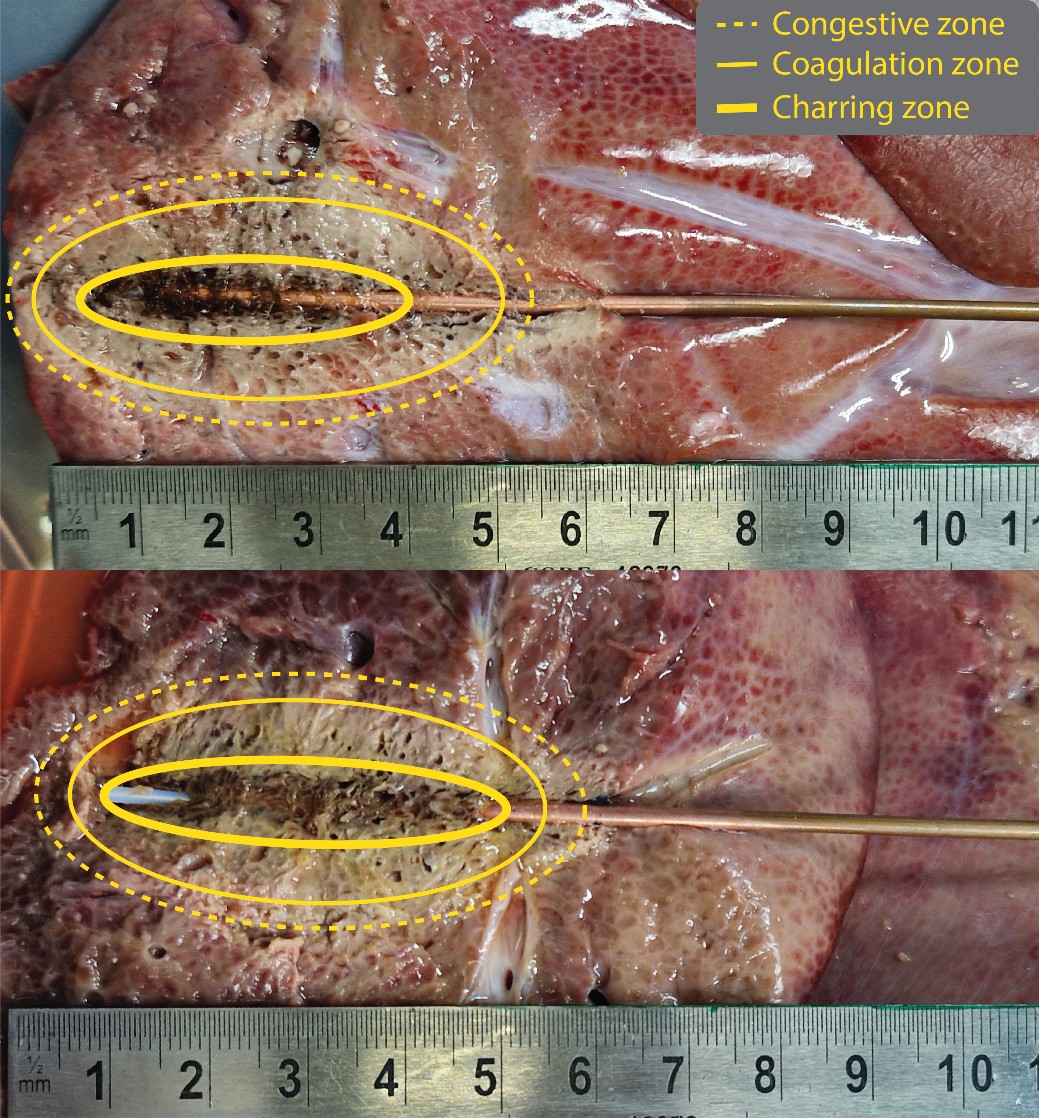
The image displays the applicator antenna and the ablation zone in dissected porcine liver tissue during two of our tests, highlighting three distinct areas: Charred, Coagulation, and Congestive.
Attachments: