-
 Welcome to plumtriA platform for Research & Innovation
 -
 Looking for Funding?Check out the current open calls
 -
 Register today to start receiving our monthly newsletter
 -
 Looking to partner up?Search our list of registered profiles
 -
 You have questions on a particular funding programme?

PGI for Maltese Wild Thyme Honey: Achievable, or forever a dream?
Image
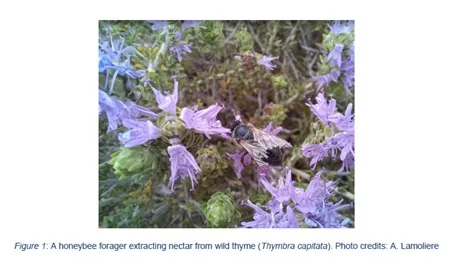
Wild Thyme Honey
Honey is distinguished according to the plants from which the bees collect their nectar. Mifsud outlines certain traits that visibly distinguish wild thyme honey (għasel tas-sagħtar): unlike most honeys, wild thyme honey ‘tends to remain in the liquid phase’, because one particularity of the thyme flower is that it contains more fructose than glucose. It is ‘the only mono-floral honey that we can produce in Malta’ (Mifsud) – that is, its nectar is primarily drawn from only one floral source. Wild thyme honey is amber in colour and has ‘a strong aromatic flavour’, says Matthew Calleja.
Maltese wild thyme honey has received international recognition, having been awarded gold at the 2021 London International Honey Awards.
Where and when does it grow?
There are three honey flows in Malta’s seasonal cycle of honey production. The spring multi-floral honey is collected by beekeepers at the end of May, with the nectar coming from different floral sources such as citrus, red clover, borage, different thistles, among others. Wild thyme shrubs flower from the end of May through June, and typically grow wild in open garrigue habitats found mostly in the northern parts of Malta, some areas in Gozo, and on Comino. Wild thyme honey is therefore also known as ‘summer honey’. This is followed by the ‘autumn honey’, in which period bees typically collect nectar from the eucalyptus trees and carob trees, producing honey that is ‘dark brown-black in colour’ (Mifsud). It is generally collected by beekeepers at the end of October to mid-November. Each of these honeys has a distinctive taste and colour.
Read full article attached below:
Attachments: External Link