-
 Welcome to plumtriA platform for Research & Innovation
 -
 Looking for Funding?Check out the current open calls
 -
 Register today to start receiving our monthly newsletter
 -
 Looking to partner up?Search our list of registered profiles
 -
 You have questions on a particular funding programme?

BeeSustain: Building the Foundations for Sustainable Beekeeping in Malta
Image
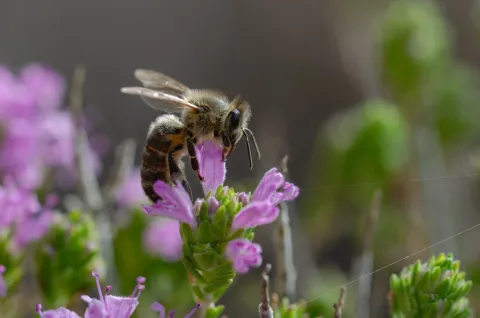
Photo credits: James Ciarlo` ©
Honey bees and other pollinators sit quietly behind much of the food we eat. By carrying pollen from flower to flower, they make it possible for most crops to set fruit. As climate change brings hotter summers, longer droughts, and an earlier, more unpredictable spring, the pressure on these small but essential workers keeps growing. Over the past years, the BeeSustain project (Integrative Modelling for Enhanced Beekeeping Carrying Capacity) set out to help Malta’s beekeepers meet that pressure with better information. Led by the University of Malta’s Biodiversity and Ecology Research Group (BERG) and funded by the Xjenza Malta Research Excellence Programme (REP) 2024, the project has now reached its conclusion, and it leaves behind a richer picture of how honey bees, other pollinators, plants, and climate fit together on the Maltese islands.
BeeSustain centred on an experimental apiary at Manikata, home to colonies of the endemic Maltese honey bee (Apis mellifera ruttneri). Earlier BERG research showed this honey bee to be especially well suited to local conditions. Around those hives, the project brought together three disciplines of science that rarely meet in one place: the biology of the honey bees and the flowers they visit, the mapping of the surrounding landscape, and the monitoring of local weather and climate conditions. What follows is a look at what each of those strands achieved.
Reading the landscape through the bees
One of the project’s most innovative strands was its use of DNA-based analysis to build a clearer picture of the plants which support bee colonies through the year via their nectiferous flowers and pollen. Analysing plant DNA collected from bee’s guts (that way, we were sure that the bees were feeding on the plant), allowed us to identify the main seasonal forage patterns around the
Photo credits: James Ciarlo` ©
Manikata apiary. The picture that emerged was as a broad and varied menu in spring, a summer strongly linked to Maltese wild thyme, and an autumn heavily reliant on eucalyptus and carob. Alongside this, honey samples were assessed for colour, consistency and taste, revealing very similar seasonal patterns.
Together, these findings show us that the food landscape available to honey bees changes dramatically over the year, an essential insight for understanding the carrying capacity of a landscape (or how many hives can an area sustainably support).
Mapping the best places to keep honey bees
To work out where bees are most likely to thrive, BeeSustain turned to environmental data. Using drone imagery and open satellite data, the team mapped the vegetation around the apiary and built a decision-making framework that ranks locations by how much good forage they offer. This was then used to estimate the “carrying capacity” of the Manikata area, roughly how many colonies the local flowers can sustainably feed. The result is both a practical figure and, more importantly, a repeatable method that can be applied to other sites across the islands.
Watching the weather around the hive
A weather station installed beside the hives recorded the local climate in fine detail, allowing researchers to describe the specific conditions the colony experiences and to compare them against Malta’s national weather records. This effort also opened an unexpected door: in the course of the
work, the team recovered and evaluated a set of observations from nine stations across the islands, producing the most detailed spatial picture yet of how Malta’s climate varies from place to place. This research is currently undergoing peer-review for scientific publication.
Bringing all of these threads into a single predictive tool proved more demanding than a project of this length could fully complete: the hive record so far covers only a single year, and some of the data needs further development before firm forecasts can be made. But this is the nature of pioneering work. BeeSustain has built the methods, and assembled the first purpose-collected datasets that a fully working system will be built upon.
Featured at the University of Malta Research Expo 2025 and feeding into new scientific publications, BeeSustain has laid firm groundwork for a smarter, more climate-resilient future for Maltese beekeeping. For more information, visit the BERG website and Facebook page
Information and image source:
Attachments: