-
 Welcome to plumtriA platform for Research & Innovation
 -
 Looking for Funding?Check out the current open calls
 -
 Register today to start receiving our monthly newsletter
 -
 Looking to partner up?Search our list of registered profiles
 -
 You have questions on a particular funding programme?

Image
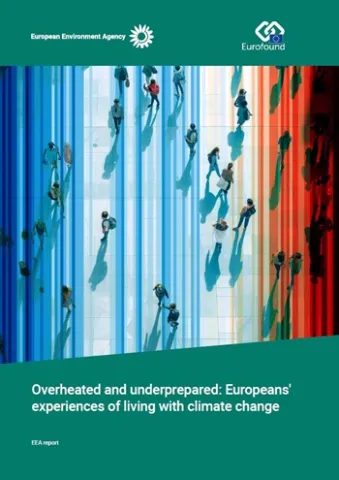
Europeans are very concerned about extreme heat and other impacts of climate change like wildfires according to the results of a Europe-wide survey published today. It found that many citizens were also underprepared to deal with the increasing frequency and magnitude of heatwaves, flooding, or water shortages in their own homes.
The results of the survey were analysed in the report 'Overheated and underprepared' published by the European Environment Agency (EEA) and the European Foundation for the Improvement of Living and Working Conditions (Eurofound). The report offers a Europe-wide overview of the perceived implementation of climate resilience measures — both those reported by survey participants at the household level and their observations of measures implemented by authorities.
This report is based on an online survey conducted by Eurofound last year involving over 27,000 respondents from across 27 European countries. It presents their experiences of climate impacts, concerns about future impacts and resilience measures they took at home and those they are aware of where they live.
Download the full report from the below link:
Information and image source:
Attachments:
The Research Networking Scheme (RNS) is a support scheme designed to strengthen Malta’s research ecosystem by supporting local and international networking, knowledge exchange, and collaborative engagement.
RNS will have 3 different schemes available:
The Local Networking Scheme for two or more Maltese Entities or Maltese and Foreign entities to collaborate and host an event related to research here in Malta!
The International Networking Scheme which covers travel costs for attending conferences abroad, short scientific missions and other research related activities.
The Open Access Journal Support – available to Xjenza Malta research grant holders to publish their results!
The primary aim of the scheme is to enhance research connectivity through activities that foster dialogue, community building, and interdisciplinary interaction across Maltese institutions.
Local Maltese public and private entities are eligible to apply for funding of up to €8,000 for networking-focused projects running over a period of 12 months. If applying to the Local Networking Scheme with a Diaspora Researcher, entities are also eligible for an additional €2,000.
Supported activities may include local networking events, researcher exchanges, workshops, roundtables, stakeholder engagement sessions, and other eligible forms of research networking, as outlined in the Rules of Participation.
For further information on this year’s call, kindly refer to the Rules of Participation and Application Form. Additional annexes may be downloaded from the Resources Page.
An information session is being held on 13 February at 13:00. Registration is recommended.
Click here to register for the Information Session
Important Deadlines:
30 March 2026 for the Local and International Networking Scheme
2 February 2027 for the Open Access Journal Support.
Temporarily closed between:
30 June 2026 to 31 August 2026
1 December 2026 to 9 January 2027
Kindly submit all documents specified in the Rules of Participation to networking.xjenzamalta@gov.mt by 30 March at 23:59 CET, keeping Ms Rachel De Bono Rachel.de-bono@gov.mt and Ms Enya Maria Haber enya-maria.haber@gov.mt in copy.
For further information, please contact:
Rachel De Bono at rachel.de-bono@gov.mt — 23602278
and/or
Enya Maria Haber at enya-maria.haber@gov.mt— 23602253
Read further on the below link:
Information and image source:
Organisation:
Xjenza Malta
Call Deadline:
Tuesday, February 02, 2027
Further Information:
External Link
Xjenza Malta is receiving proposals under the ERC Support Scheme. The Scheme aims to strengthen the opportunities for talented researchers to obtain grants from the ERC (European Research Council) for excellent and ground-breaking research based on researchers’ own ideas within all areas of research. The Scheme is divided into two options. Applicants are to fill in the appropriate sections of the form; they may select either Option A or Option B, or both:
Option A: Mentoring initiative
The mentoring initiative will support potential ERC applicants by helping to identify international experts to provide coaching and advice.
Applicants interested to benefit from the ERC Mentoring Initiative are to indicate their interest and detail the mentoring activities they require. An expected workload and envisaged compensations for the mentors are to be specified.
The maximum cost for Option A should be up to €5000 (inclusive of VAT). The Mentors are to be selected by a list of Mentors which will be provided by Xjenza Malta.
Option B: Proposal writing trainings.
The objective of this activity is to raise the capabilities of potential ERC candidates to prepare successful ERC grant applications through attending ERC proposal writing trainings.
The training activities may take place in any EU Member State or Associated Country physically or online. The trainers must have extensive experience and proven track record in running ERC workshops and helping successful ERC grantees. The duration of the physical trainings should be of minimum 1 day and maximum 5 days. No restrictions apply for the online trainings.
Interested Applicants are to contact Lili Kankaya lili.vasileva@gov.mt
The call will be open until 25th September 2026 (final deadline) with a cut off on 15th May 2026 in between.
Visit the below link to download the guidelines and application forms.
Information and image source:
Organisation:
Xjenza Malta
Call Deadline:
Friday, September 25, 2026
Further Information:
External Link
The Training Centre of the Bulgarian Academy of Sciences invites leading scientists and innovators from Bulgaria and abroad to give lectures for PhD students and young scientists with thematic emphasis on the dual transition towards green and digital economy. The activity is within the frame of the project “Enhancing the expert capacity of the Training Centre at the Bulgarian Academy of Sciences” (code BG-RRP-2.021), financed under investment C2I2 of the National Recovery and Resilience Plan of the Republic of Bulgaria.
Download the below invitation for further information
Document
Invitation Lectures BAS.pdf
(1.08 MB)
Scientists and innovators may submit the documents listed above personally or via nomination by research units at BAS until 15.02.2026 at the following email address: m.vassileva@cu.bas.bg
Information source:
Organisation:
Training Centre of the Bulgarian Academy of Sciences
Application Deadline:
Sunday, February 15, 2026
Email address:
m.vassileva@cu.bas.bg
Further Information:
External Link
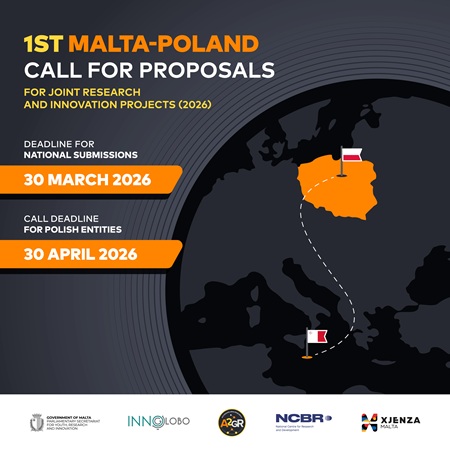
Xjenza Malta, in collaboration with Poland’s National Centre for Research and Development (NCBR), has officially launched the Malta–Poland 2026 Joint Call for Research & Innovation, aimed at supporting cross-border cooperation between Maltese and Polish entities. The Call seeks to strengthen bilateral collaboration in priority areas of shared national interest and to encourage innovative solutions with international impact.
The initiative is co-funded by Xjenza Malta through the Access2GlobalResearch (A2GR) Scheme and by NCBR through the INNOGLOBO Programme.
Thematic Areas
For this first Joint Call, proposals must address one or more of the following thematic areas:
Marine & Maritime Technologies
Digital Technologies
Health & Well-being
Sustainable Use of Resources
Smart Manufacturing
Aerospace, Aviation & Space
Cultural Heritage
Funding and Consortium Requirements
A Malta-based consortium may receive up to €150,000 in funding. Proposals must be submitted by Malta–Poland consortia, consisting of at least one eligible Malta-based entity and one eligible Poland-based entity.
Deadlines
Malta-based entities: 30 March 2026
Poland-based entities: 30 April 2026
These deadlines ensure both national and international submission procedures are respected, including administrative assessments and declarations of co-financing.
Online Information Session
Date: 6 February 2026
Time: 10:30–11:00 CET
Registration Deadline: 4 February 2026
How to Participate
Further information, including national rules, application documentation, and submission procedures for Malta-based applicants, is available via the Xjenza Malta Call Page.
For enquiries from Malta-based applicants, contact:
📩 sandrine.borg.1@gov.mt and international.xjenzamalta@gov.mt
Poland-based applicants should refer to NCBR for national documentation and submission processes.
Information and image source:
Organisation:
Xjenza Malta
Call Deadline:
Monday, March 30, 2026
Further Information:
External Link
SciLifeLab PULSE is a comprehensive Marie Skłodowska-Curie Actions (MSCA) Cofund postdoctoral program, that will train 48 future leaders in life sciences. The program focuses on innovative, fundamental and translational research carried out in supportive and diverse academic and industrial environments, preparing postdocs with necessary skills for long-term career sustainability.
PULSE offers 3-year fellowships hosted by SciLifeLab group leaders at 11 Swedish universities with secondments at 29 academic and non-academic partners in Sweden and abroad. With the first cohort of postdocs having started in October 2025, the stage is set for the next group to join on October 2026. Don’t miss this unique opportunity – application period open December 15, 2025 to March 16, 2026!
Download their brochure:
Document
Flyer PULSE_251126.pdf
(874.05 KB)
Visit the below link for further information.
Information source:
Organisation:
SciLifeLab Pulse
Application Deadline:
Monday, March 16, 2026
Email address:
see link below
Further Information:
External Link
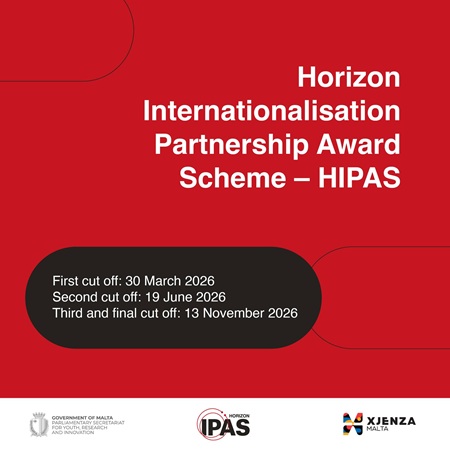
Xjenza Malta is receiving proposals under the Horizon Internationalisation Partnership Award Scheme (HIPAS). The Scheme will support Maltese eligible entities intending to submit a Horizon Europe proposal (including Partnerships indicated in the Scheme Rules), as a Coordinator entity to engage a service provider (local or foreign) who will be supporting the applicant entity through proposal writing and submission. The support is limited to € 8,000. More details can be seen the rules.
Interested Applicants are to submit their application form electronically to horizon.malta@gov.mt keeping Lili Kankaya lili.vasileva@gov.mt in copy with “HIPAS – Application 2026” as a subject heading. The call will be open throughout the year (until 13th November 2026) with the following cut offs:
30th March 2026
19th June 2026
13th November 2026 (final deadline)
Kindly download the application forms and guidelines from the below link:
Information and image source:
Organisation:
Xjenza Malta
Call Deadline:
Friday, November 13, 2026
Further Information:
External Link
Image
The European Commission has launched a Call for Evidence on the upcoming revision of EU rules for protecting the marine environment, including the Marine Strategy Framework Directive, MSFD.
The initiative aims to assess what has worked so far, where implementation has fallen short, and how EU legislation can better support the health and resilience of European seas.
This is a chance for researchers, civil society, industry and other stakeholders to share experience and evidence that can inform the next phase of EU marine policy.
The call is open for feedback via the Commission’s portal link below:
Forward your feedback by 9 March 2026.
Information and image source:
Attachments:
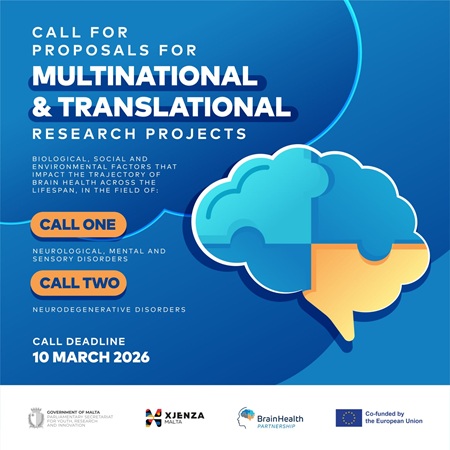
The European Partnership for Brain Health (EP BrainHealth) gathers 54 partners from 33 countries, with the common goal of improving brain health for all by developing scientific knowledge as a foundation to promote brain health throughout the lifetime, to prevent and to cure brain diseases as well as to improve wellbeing of people living with neurological and mental disorders in Europe and beyond.
Xjenza Malta together with other Research Funding Organisations, co-funded by the European Union have launched the 1st Two Joint Transnational Calls to financially support R&I projects.
Malta-Based entities are eligible to apply for funds up to €500,000 per project, to join a consortium and submit a proposal to one of the following Calls:
Call 1: Biological, social and environmental factors that impact the trajectory of brain health across the lifespan – in the field of neurological, mental and sensory disorders
Call 2: Biological, social and environmental factors that impact the trajectory of brain health across the lifespan – in the field of neurodegeneration
Xjenza Malta will be holding an online Info Session on 5 February 2026, 11:00 CET: Register now!
Application Deadlines
Project coordinator needs to submit the pre-proposal via the BrainHealth Electronic Submission Tool by 10 March 2026, 14:00 CET.
Each Malta-based applicant must submit a signed National Application Form to eusubmissions.xjenzamalta@gov.mt by 10 March 2026, 23:59 CET.
Announcement
National Launch Event at Xjenza Malta premises on 28 January 2026, 10:30-13:30 (CET) – Click here to register
We strongly encourage interested stakeholders to review the Call documentation and consider joining an international consortium under this important initiative to advance brain health research in Europe and beyond.
For further details, visit the Xjenza Malta EP BrainHealth Webpage and the EP BrainHealth Website.
For any queries, you may contact us at eusubmissions.xjenzamalta@gov.mt
Information and image source:
Organisation:
Xjenza Malta
Call Deadline:
Tuesday, March 10, 2026
Further Information:
External Link
Image
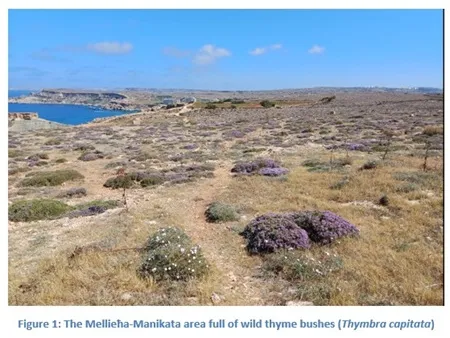
Honey production in Malta plays out on a small island with a tightly mixed landscape. Beekeepers work across fields, garrigue and settlements that sit close together, yet they are expected to deliver a product with a clear representation of the place, and one of these is Maltese wild thyme honey. The main challenge lies in making sure that the bees forage mainly from the flowers of wild thyme in such a tightly-knit landscape.
Drones and artificial intelligence make that challenge surmountable. Drone surveys and machine learning can convert thousands of overlapping images into maps that show thyme cover and thyme’s potential competitors. This study asks whether Malta can realistically and sustainably support monofloral wild thyme honey (honey made mostly from thyme nectar), and if so, where. By combining drone surveys, multispectral imaging, GIS and supervised machine learning, the team searched for thyme-exclusive conditions during the early dry-summer window (end of May to early July). Focusing on the Mellieħa-Manikata area, the analysis identified an approximately 8-kilometre zone where thyme appeared to be the dominant flowering species during bloom.
Biological and geographic constraints on mono floral honey
Honey bees respond to nectar rewards, not to human labels such as "thyme honey". Most foraging occurs within a few kilometres of the hive, yet bees can travel to around 4.5 kilometres and sometimes approach 5 kilometres. In Malta, a circle of that size usually crosses multiple habitat types and land uses. Even where thyme dominates, other nectar sources can occur along field margins, gardens or disturbed ground, creating naturally multifloral honeys.
This means the true botanical origin of honey depends on spatial context: it is not enough to have thyme near the hive; competing melliferous plants must be absent, or negligible, within reach during the key weeks of nectar flow. Field walks rarely cover an entire foraging radius at fine detail, and flowering can change quickly. Drone mapping and AI classification close that gap by surveying large areas rapidly and classifying flowering resources consistently across the whole map.
Research collaboration and study objectives
The work was developed through collaboration between the Biodiversity and Ecology Research Group (BERG) at the University of Malta and the Intelligent Agriculture and Livestock Applications Laboratory (Intala Lab) at Isik University in Turkiye, within a wider effort to apply ICT tools to apiculture. The partnership combined local ecological knowledge with expertise in sensing, analytics and applied machine learning. This was done though the project known as ‘Bee-Optech4Honey’, funded by Xjenza Malta and TUBITAK.

The Maltese objective was straightforward: determine whether any area could support monofloral Maltese wild thyme honey based on the spatial availability of nectar sources across a bee's foraging range. The team aimed to produce decision-ready outputs that can inform hive placement and support monofloral labelling.
Methods overview: Drone surveys, multispectral imaging, and GIS analysis
Surveys were flown in June, when Maltese wild thyme is in bloom and produces a strong visual and spectral signal. Mapping during bloom improves separability for both human interpretation and machine learning, and it increases the chance of detecting any competing melliferous blooms that could influence honey during the same period.
A drone equipped with a DJI Mavic 3 Multispectral camera captured imagery in visible and infrared bands (DJI, Mavic 3 Multispectral specifications). Multispectral data add diagnostic information beyond standard RGB photographs because plants and flowers reflect light differently across wavelengths. The imagery was processed using photogrammetry to produce georeferenced orthomosaics and digital elevation models (DEMs), creating a map-like surface where each pixel is tied to coordinates.

Supervised machine learning was used to map thyme distribution. Labelled examples of flowering thyme were used to train a deep learning classifier to recognise thyme-specific spectral and textural patterns, and the model was applied across the orthomosaic to generate a classified thyme layer. GIS analyses then evaluated whether alternative melliferous resources occurred within bee-relevant distances, translating classification into forage-zone evidence.
Key findings: A unique thyme-only zone in Mellieħa
The drone-AI pipeline produced a result with direct operational value. In the Mellieħa-Manikata region, classification outputs indicated an approximately 8-kilometre zone where Maltese wild thyme was detected as the only melliferous flowering species during the survey window. Other vegetation occurred, but competing nectar-producing blooms were not observed within that mapped area for that period.
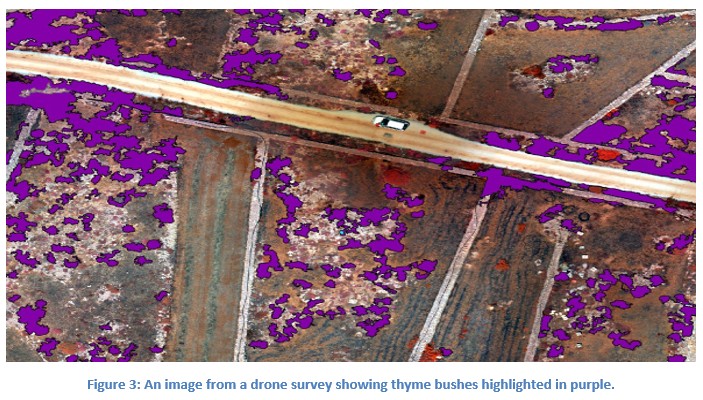
The key feature is scale and continuity. A thyme-rich patch does not guarantee monofloral honey, but a thyme-only landscape large enough to contain a full foraging radius changes the odds decisively. If colonies are placed near the centre of the mapped zone, a typical foraging radius of up to around 4.5 kilometres, and even the upper bound near 5 kilometres, can remain largely inside a landscape where bees have no alternative nectar to choose during bloom. The result is a strong ecological basis for monofloral honey grounded in mapped forage availability.
Implications for honey provenance and certification
Strong provenance claims link a product to the environment that produced it. Laboratory analysis can characterise honey after harvest, but it does not always show what resources were available to the bees while nectar was being collected. Drone and AI mapping fills that gap by documenting the forage landscape within reach of a colony at the relevant time.
In practical terms, the thyme-only zone functions like a natural provenance envelope. When colonies are placed centrally and managed during the thyme flowering period, the monofloral claim can be supported by an evidence chain: timed drone surveys, georeferenced orthomosaics, AI classification layers quantifying thyme cover, and GIS analyses demonstrating that the foraging circle sits inside a thyme-only landscape. This creates a transparent, repeatable record that can complement laboratory verification and strengthen certification discussions.
Land use considerations and policy relevance
The findings have a clear policy message: in this case, hive placement is critical. Colonies placed near the edge of the thyme-only zone can forage beyond it, increasing exposure to alternative nectar sources. Colonies placed nearer the centre keep the foraging radius within the mapped envelope, preserving the ecological conditions that favour monofloral production.
This creates an opportunity for evidence-based site designation. Instead of treating beekeeping sites as interchangeable, authorities can recognise that some locations have unique forage properties that directly influence product character. The drone-AI pipeline also offers a monitoring tool: repeat flights can confirm whether thyme-only conditions hold across seasons, rainfall variation or land-use changes, allowing guidelines to be updated with fresh evidence.
Broader significance for Malta's agricultural and cultural landscape
This work illustrates how modern sensing can support traditional products by making their ecological foundations visible. Maltese wild thyme honey has cultural meaning, and drone plus machine learning methods translate that meaning into spatial criteria that can be mapped, communicated and revisited.
The same approach is adaptable to other origin-linked foods and crop-pollinator systems: map resources at the right time, classify them with transparent models, and use GIS to connect maps to real foraging dynamics. For Malta, where space is limited and land-use pressure is high, targeted, data-led strategies can focus support on places where the ecological conditions genuinely favour monofloral production.
Conclusion: A data driven path to authentic Maltese thyme honey
The Mellieħa-Manikata study shows that monofloral Maltese wild thyme honey can be supported by spatial evidence. By surveying flowering resources using drone-borne multispectral imaging, processing imagery into orthomosaics and DEMs, and applying supervised machine learning within a GIS framework, the team identified an approximately 8-kilometre zone where Maltese wild thyme was the only melliferous flowering species detected during early summer.
Given known honey bee foraging distances, colonies placed centrally within this thyme-only zone would be expected to forage almost exclusively on thyme during bloom, providing a strong ecological basis for monofloral origin. For policymakers, the implication is practical: enabling controlled colony placement in this specific area is a targeted decision supported by a method that can be repeated over time to verify that forage conditions remain suitable.
Information and image source:
Author: Mark Mifsud
Editors: David Mifsud, Matthew Calleja
Attachments: Subscribe to