-
 Welcome to plumtriA platform for Research & Innovation
-
 Register today to start receiving our monthly newsletter
-
 Looking for Funding?Check out the current open calls
-
 Looking to partner up?Search our list of registered profiles
-
 You have questions on a particular funding programme?

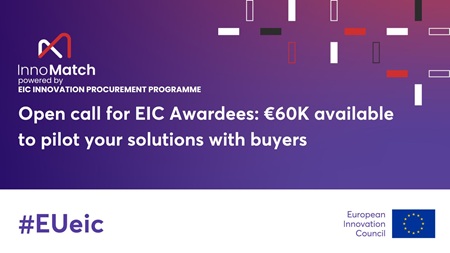
EIC Awardees and Buyers, which will provide financial support up to €60.000 per pilot to develop their innovative solutions.
For further information visit the below link and watch the recording of the information session here below.
Video URL
Information and video source:
Organisation:
InnoMatch
Call Deadline:
Monday, February 02, 2026
Further Information:
External Link
Image

Imagine breaking a bone so severely that a piece is missing. Or imagine recovering from bone cancer, only to be left with a gap your body cannot heal on its own. Today, patients in these situations often rely on metal implants that stay in the body forever or require a second surgery to remove.
OsteoMag-3D is an international partnership that brings together Maltese and Chinese researchers with one shared goal: to create patient-specific bone implants made from a biodegradable magnesium alloy. These implants, often called scaffolds, act as temporary bone substitutes in situations where patients are left with missing bone, such as after bone cancer treatment or when fractures fail to heal. They support new bone growth and gradually dissolve as healing progresses. Over time, they are replaced entirely by natural bone, eliminating the need for a second surgery to remove the implant.
To ensure each patient gets the right fit, OsteoMag-3D uses advanced 3D-printing technology (Figure 1) to customise the implants. This is not the type of 3D printer found at home. Instead, it relies on a high-precision method called Laser Powder Bed Fusion, where a focused laser beam melts extremely fine magnesium powder layer by layer to form a tailored implant with excellent accuracy.
The project brings together four main institutions. From Malta, the University of Malta leads the initiative under Prof. Inġ. Joseph Buhagiar, working closely with consultant orthopaedic surgeon Mr Ryan Giordmaina from Mater Dei Hospital. Their Chinese partners are Southeast University, led by Prof. Jing Bai, and Jiangxi University of Science and Technology under Prof. Youwen Yang. This collaboration combines expertise in materials engineering, mechanical engineering, medical science, and clinical practice.
Magnesium is an exciting material for scaffolds. It behaves similarly to natural bone, is biocompatible, and even releases by-products that can encourage healing. But magnesium also has its issues. Placed inside the body, it can degrade too quickly, vanishing before the bone has fully healed. Its breakdown also produces hydrogen gas, which can create unwanted pockets around the implant. OsteoMag-3D researchers are developing new surface coatings to slow and control this process.
Although the technology is highly promising, it remains in the research stage, and the OsteoMag-3D implant is not yet available on the market. Before any patient can receive such an implant, it must undergo rigorous laboratory testing, clinical trials, and regulatory approval. This process is long and expensive; but essential. Close collaboration between engineers and orthopaedic surgeons ensures that the technology will be safe, effective, and suitable for future clinical use.
The OsteoMag-3D project represents a promising step forward in orthopaedics, with the potential to greatly improve the quality of life for patients who require a bone substitute due to injury or disease. The project receives funding from the Ministry of Science and Technology of the People’s Republic of China (2025YFE0110100) and Xjenza Malta through SINO-MALTA-2024-11 (Science and Technology Cooperation).
Visit the below link to watch the video and read further.
Information and image source:
Attachments:
PRIMA is seeking a Director for its Secretariat, based in Barcelona, Spain.
Position: Director – PRIMA Foundation Secretariat
Location: Barcelona, Spain
Contract Duration: 5 years (renewable once for a maximum of 5 additional years)
Application Deadline: 15 February 2026 (23:59 CET)
The Director will lead the PRIMA Foundation Secretariat, overseeing the strategic direction and operational management of the organisation’s research and innovation programs across the Mediterranean.
Visit the below link to read further.
Information and image source:
Organisation:
PRIMA Foundation
Application Deadline:
Sunday, February 15, 2026
Email address:
see link below
Further Information:
External Link
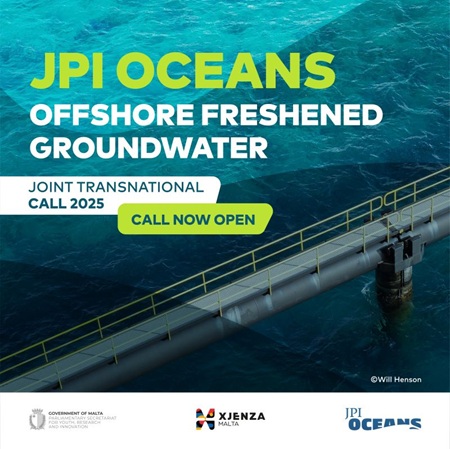
A new Joint Call under the JPI Oceans OFG initiative, co-led by Xjenza Malta and Italy’s MUR has been launched. This Call aims to serve as a “proof of concept” through a pioneering scientific exploration and validation campaign. It seeks to pave new pathways for a water-secure future by bridging cutting-edge science with responsible policymaking and community well-being.
Call’s focus topics:
- Comprehensive characterization and validation of OFG bodies
- Environmental, technological, and economic feasibility of OFG utilisation
- Legal and governance frameworks for sustainable management
Xjenza Malta is supporting successful Malta-based entities, both public and private, with up to €300,000 per project. Deadline to submit proposal and National application: 6 March 2026.
Read further by visiting the below link.
Information and image source:
Organisation:
Xjenza Malta
Call Deadline:
Friday, March 06, 2026
Further Information:
External Link
Image
What are the purposes of this survey?
To identify what types of capacity building activities are considered important in order to support research and innovation in health and care systems;
To get an overview of current capacity building instruments available at national and international levels that can help drive the transformation of health and care systems.
What is capacity building in the context of research and innovation?
Capacity building in the context of R&I refers to the process of enhancing the skills, knowledge, systems, infrastructures and collaborations of individuals and organisations that are active in the field of research and innovation. It can e.g. involve research training or fellowships, but also building platforms or networking opportunities for knowledge sharing across institutions.
Who can respond?
The survey is open to anyone in Europe and beyond. We are interested in the views of senior and junior researchers, R&I funders, policymakers, patient/citizen representatives, health and social care professionals, industry representatives and anyone who is interested in capacity building for R&I in relation to health and care systems.
Will my responses be identifiable?
No. All responses are treated anonymously. We will ask some general information about your background for analysing purposes, but we will make sure there is no risk of disclosing your identity when reporting the findings of the survey.
How long does this survey take?
Approximately 15 minutes, but this can vary depending on the number of questions you choose to answer and the input you wish to provide.
Visit the below link to read further and participate.
Information and logo source:
Attachments:
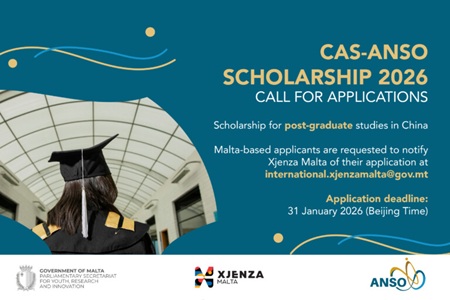
The Alliance of International Science Organizations (ANSO), in partnership with the Chinese Academy of Sciences (CAS) and other founding institutions, has launched the 2026 CAS-ANSO Scholarship Program. Established in 2019 (originally as the ANSO Scholarship for Young Talents), this program aims to develop and empower the next generation of scientists.
The Program offers postgraduate study opportunities at institutes of Chinese Academy of Sciences (CAS), the University of Chinese Academy of Sciences (UCAS), and the University of Science and Technology of China (USTC). Annually, the program supports 300 doctoral students and 100-200 master’s students. Participants will engage in a comprehensive curriculum, including Chinese language and cultural studies, coursework, research projects, and thesis development at their host institutions.
The scholarship covers:
Full tuition fees
Monthly stipend
Health insurance
International travel reimbursement/allowance
Application fee waiver
Visa and residence permit support
Eligibility Requirements: Applicants for the master’s program must be born on or after January 1, 1996, and for the PhD program, on or after January 1, 1991. All candidates must satisfy the entry requirements for international students at either USTC or UCAS. Students already enrolled in master’s or PhD programs in China are ineligible.
The application window for the 2026 academic year is currently open, with submissions due by 31st January 2026 (Beijing Time).
Malta-based applicants are requested to notify Xjenza Malta of their application at international.xjenzamalta@gov.mt
For further program details, eligibility criteria and contact details, potential candidates may visit the ANSO website.
Information and image source:
Organisation:
CAS-ANSO
Application Deadline:
Saturday, January 31, 2026
Email address:
international.xjenzamalta@gov.mt
Further Information:
External Link
Image

Intellectual property (IP) management is a key element in improving the competitiveness of any company. Unfortunately, small and medium sized enterprises (SMEs) often lack the time, resources, or knowledge to address IP matters. This guide aims at providing answers to some of the main IP issues often faced by SMEs. It has been developed on the basis of the answers provided by the European IP Helpdesk to some of the Frequently Asked Questions (FAQs) submitted by users through the European IP Helpdesk website and Helpline. Moreover, it refers to several reference documents, which are listed at the end of each section for further information. Each section of this guide is dedicated to one specific IP right, covering essential aspects around its regulation in Europe as well as some additional questions which, based on the experience of the European IP Helpdesk, are of interest to European SMEs. This guide is making no claim to be exhaustive and is not an official document of the European Commission. It is provided as a service of the European IP Helpdesk. This is an updated version of the IP Guide originally developed and first published in October 2019.
Visit the below link to download the guide book.
Information and image source:
Attachments:
The THCS Joint Call Secretariat is seeking experts for the evaluation of proposals submitted in the Joint Transnational Call 2026 "Access to Care".
The aim of the call is to fund research and innovation projects that, within an ecosystem approach, contribute to ensuring equitable access to and utilisation of health and care services. Through the funded research and innovation projects, policy and decision makers should gain the knowledge and tools necessary to implement the reallocation of resources as the health and care system undergoes a transition to meet new and ongoing challenges. The call involves more than 30 funding agencies with an indicative budget of over €35 million.
We are seeking experts with a strong background and proven experience in research and implementation related to the transformation of health and care systems to reduce inequalities. Ideal candidates will possess expertise in public health, health services research, and health policy evaluation, particularly focusing on addressing disparities stemming from socio-economic status, geographical location (e.g., medical deserts, rural/remote areas), and identity factors (racial, cultural, gender).
We require professionals proficient in ecosystem-based and interdisciplinary approaches to healthcare, including the development and testing of innovative models of care, integration of digital health solutions (e.g., digitally enabled care pathways), and research into health equity and literacy (including digital literacy).
Expertise in implementation science, case study development, policy analysis, and assessing scalability and transferability of interventions across different national or regional contexts is highly valued.
We are looking for experts who understand both individual and structural barriers to access and can critically analyse usage patterns (under-/overutilization) to propose sustainable, evidence-based solutions.
Role of the expert:
The duty of the expert will concern the preparation of written reviews of submitted pre- and full proposals and participation in the online panel meetings in which proposals will be discussed.
Each expert will be invited to review ± 10 projects. The written reviews will be performed online in the THCS portal.
Join an online instructions meeting of 1,5 hour.
Experts will be paid for their participation in the evaluation process (only if they have performed written reviews and attended the panel meetings).
Visit the below link to read further.
Information and image source:
Organisation:
THCS Joint Call Secretariat
Application Deadline:
Thursday, January 08, 2026
Email address:
see link below
Further Information:
External Link
Image
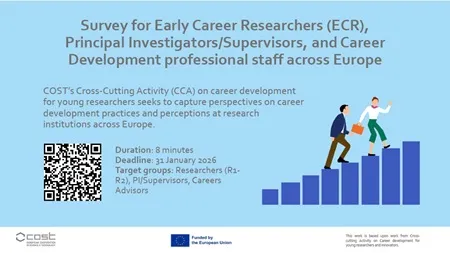
Calling all Early Career Researchers, Principle Investigators and Supervisors, and Career Advisors - COST need your input in a quick survey focused on career development initiatives. By participating, you will contribute to an evidence base that can inform fairer and more inclusive career development opportunities.
Duration of the survey is estimated at 8 minutes.
Deadline: 31 January 2026
Visit the below link to read further and participate.
Information and image source:
Attachments:
Image
Advanced materials provide the innovative solutions needed for a more efficient, sustainable and competitive industry. Given the current geopolitical landscape, the EU needs to strengthen its research, innovation and production capacities and accelerate their uptake in Europe.
The Advanced Materials Act will put forward measures to achieve open strategic autonomy on advanced materials. This will help reduce dependencies on critical resources and boost EU competitiveness.
Feedback deadline: 13 January 2026
Visit the below link to read further and participate.
Information and image source:
Attachments: Subscribe to