-
 Welcome to plumtriA platform for Research & Innovation
-
 Register today to start receiving our monthly newsletter
-
 Looking for Funding?Check out the current open calls
-
 Looking to partner up?Search our list of registered profiles
-
 You have questions on a particular funding programme?

Image

The Department of Food Science, Nutrition and Dietetics at the University of Malta is part of DIVERSICROP (COST Action CA22146), a global research network studying consumer interest in underutilized crops. Malta is contributing to this international effort with the study: “Consumer Attitudes and Interest in Underutilized Crops.”
This research explores how cultural and traditional dietary habits in Maltese adults influence awareness, acceptance, and use of these lesser-known crops. You're invited to take part by completing a short, anonymous survey — it takes about 10 minutes.
Participation is entirely voluntary
You are free to accept or refuse to participate, without needing to give a reason.
You are free to skip any questions or to withdraw from filling in the survey at any time when filling it in, without needing to provide any explanation and without any negative repercussions for you.
There are no risks or direct benefits to you.
At no point will you be asked to provide your name or any other personal data that may lead to you being identified.
The survey instrument used will not collect IP addresses, which may constitute personal data.
Consent is implied by completing the survey.
Data collected will be used solely for this research and may be published in aggregated form in academic journals or presented at conferences. Only the DIVERSICROP research team and local investigators will access the data. This study is approved by the Research Ethics Committee of the Faculty of Health Sciences, University of Malta.
Visit the below link to participate in this survey.
Information and image source:
Attachments:
The Internationalisation Executive is responsible for promoting, managing, and overseeing Xjenza Malta’s participation in international research and innovation (R&I) programmes, both bilateral and multilateral. The role entails leading specific programmes, initiatives, and measures, with a focus on the effective management of funding opportunities across various thematic areas. Key responsibilities include the administration of transnational calls, stakeholder engagement, and the planning and execution of dissemination and promotional activities. The Executive will be an integral member of the Internationalisation Unit (IU) within Xjenza Malta (XM), contributing to the organisation’s strategic internationalisation efforts.
Visit the below link to read further.
Information source:
Organisation:
Xjenza Malta
Application Deadline:
Thursday, October 23, 2025
Email address:
The Internationalisation Executive is responsible for promoting, managing, and overseeing Xjenza Mal
Further Information:
External Link
The purpose of the Administrator role within Xjenza Malta technical units is to provide comprehensive administrative support that enhances the overall effectiveness and efficiency of the respective unit's operations. The role involves assisting in the dissemination and promotion of activities, supporting the implementation and management of various initiatives and measures, and contributing to the smooth coordination of events, consultations, and daily operations. Additionally, the Administrator is responsible for supporting the broader administrative needs of the respective unit to ensure streamlined processes and effective communication.
Click on the below link to read further.
Information source:
Organisation:
Xjenza Malta
Application Deadline:
Friday, November 21, 2025
Email address:
recruitment.xjenzamalta@gov.mt.
Further Information:
External Link
Image

A fascinating fact I first encountered during my undergraduate studies involved people who, years ago, claimed to hear voices in their heads. The culprit wasn’t the supernatural, it was radiation. Metal fillings in their teeth were acting like tiny antennas, picking up radio waves from broadcasting towers.
That was my first glimpse into how parts of the human body could interact with electromagnetic radiation from the outside world. Today, my research takes this idea further but instead of radio waves, I work with microwaves, and instead of dental fillings, my focus is on tumours. This is a crucial step towards improving treatment and survival outcomes for cancer patients.
Heating Tumours to Heal
Microwave hyperthermia is a treatment that uses temperatures slightly higher than normal to damage and weaken tumour cells. A set of small antennas placed outside the body emits microwave radiation, which converges precisely at a targeted point inside. Due to constructive interference, this point heats up, much like how multiple waves in a pool can meet to create a larger wave.
The rise in temperature triggers a cascade of biological effects:
Proteins within tumour cells denature, disrupting their normal functions.
Tumour growth slows, while blood flow increases, making subsequent treatments delivered through the bloodstream more effective.
Remarkably, this is achieved with minimal side effects. When administered correctly, the only reported discomfort is mild skin irritation or slight unease during the procedure.
Microwave hyperthermia isn’t designed to replace chemotherapy or radiotherapy, it strengthens them. By precisely heating tumour tissue before these traditional treatments, hyperthermia increases their efficacy. A typical session lasts 30 to 60 minutes, with the patient lying still to ensure healthy tissues remain unaffected.
Around the world, hospitals are increasingly incorporating hyperthermia into cancer treatment plans. Clinical studies are showing promising results, demonstrating improved treatment responses and patient outcomes.
In order to understand the technology, think of a microwave phased array as a team of flashlights working in perfect synchrony. Instead of shining light randomly, each ‘flashlight’ (or antenna) coordinates to focus energy precisely where it’s needed, similar to how a magnifying glass focuses sunlight. By carefully controlling the timing of signals from each antenna, the system concentrates microwaves at a single location while cancelling them elsewhere. This technology allows for non-invasive, highly targeted heating inside the body, the same principle that underpins wireless charging, security scanners, and other advanced systems.
As part of my research at the University of Malta, I am developing a next-generation microwave hyperthermia system that rivals current clinical systems in accuracy and efficiency. My goal is simple: to make cancer treatment more effective, more comfortable, and more accessible to those who need it.
This work, “Hyper4B” is financed by Xjenza Malta and the Scientific Technology Research Council (TÜBİTAK), through the Xjenza Malta-TÜBİTAK 2023 Joint Call for R&I projects.
About the Author: Therese Quattromani is an electronics engineer reading for a master’s degree at the University of Malta
Information and image source:
Attachments:
Image

While awaiting the publication of the official notice in the Official Gazette, the following documents are now available online:
The text of Public Call No. 2/2025 for the submission of cooperation project proposals under the INTERREG VI-A Italy-Malta Programme;
The related selection criteria for operations, approved by the Programme Monitoring Committee on 29/07/2025.
The text of the call and the selection criteria are published for informational purposes only and may be subject to minor changes. They do not have legal value until their publication in the Official Gazette of the Region of Sicily.
Visit the below link to download the full documentation.
Information and logo source:
Attachments:

Visit the below link to view the 15 funding opportunities under Cascade Funding, an instrument by the European Commission.
Please note that these calls have different deadlines within the month of October 2025.
Information and image source:
Call Deadline:
Friday, October 31, 2025
Further Information:
External Link
Image

This funding guide was developed in response to requests from the Japanese research community and brings together, in a single document, information on funding opportunities available in both the EU and Japan.
The guide is organised around key stages and interests in a research career, from doctoral training and postdoctoral research to independent research, international mobility, collaborative or consortium-based projects, and even the commercialisation of research results. For each area, it outlines relevant funding opportunities on both the EU and Japanese sides.
Information and image source:
Attachments:
Image
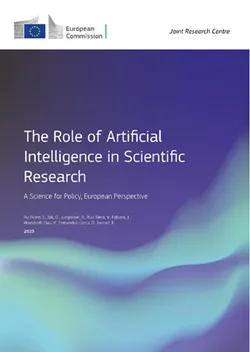
Artificial Intelligence (AI) is fundamentally transforming the scientific process across all stages, from hypothesis generation and experimental design to data analysis, peer review and dissemination of results. In many research fields, such as the examined protein structure prediction, materials discovery and computational humanities, AI accelerates discovery, fosters interdisciplinary collaboration and enhances reproducibility, while improving access to advanced analytical and computational capabilities. These developments align with the European Union (EU)’s vision to make AI tools and infrastructure more accessible, strengthening research in areas of strategic importance such as climate change, health, and clean technologies. However, this progress introduces new challenges, including concerns about algorithmic bias, the proliferation of hallucinations and fabricated data, and the potential erosion of critical thinking skills. AI Adoption remains uneven across scientific domains, and addressing these risks requires robust governance, transparency and alignment with open-science principles. This report, accompanying the publication of the European Strategy for AI in Science, provide scientific evidence to support policymakers in maximising AI’s benefits for EU’s research excellence, innovation and competitiveness, while ensuring its deployment in science remains ethical, inclusive and aligned with European values.
Read the full report by clicking on the below link.
Information and image source:
Attachments:
Image
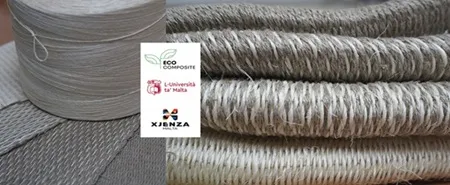
The widespread use of synthetic glass and carbon fibres in the composite manufacturing industry offers strength and rigidity but poses environmental challenges. Synthetic fibres and resins are derived from petrochemicals, are difficult to recycle, and may pose environmental or health risks during production. Natural fibres, such as sisal and flax, present a more sustainable alternative, especially when paired with biodegradable resins. Flax derived from the Linseed plant, has strong mechanical properties but is costly to cultivate, while Sisal extracted from the Agave Sisalana plant is cheaper and easier to grow but harder to process. Hybrid composites using both fibres can enhance performance, lower costs, and improving sustainability. The project ECO-Composite developed Hybrid Flax/Sisal bio-based composites and investigates the mechanical, environmental, and processing aspects of such hybrid applications to support greener industrial materials.
ECO-Composite project received funding from Xjenza Malta and the Ministry for Science and Technology of the People’s Republic of China (MOST), through the SINO-MALTA Fund 2022 Call (Science and Technology Cooperation).
Information and image source:
Attachments: External Link
Image
Imagine the ability to produce a critical spare part—such as a precision bracket used to securely mount components—within hours rather than weeks. This is the transformative potential of metal additive manufacturing, commonly known as metal 3D printing. This innovative technology is currently being researched at the University of Malta.
While metal 3D printing offers incredible rapid production turnaround and design flexibility, one key limitation persists: surface quality. Parts produced by powder bed fusion and other AM techniques typically exhibit high roughness due to incomplete powder melting and due to the so-called staircase effect, which results from the inherit layered nature of the process. These surface defects can compromise the mechanical and tribological performance of fabricated parts when compared to their conventionally manufactured counterparts. To address this challenge, the Green Laser Post-Processing in Additive Manufacturing (GLAM) project has been focusing on improving the surface finish through a combination of process optimisation and post-processing techniques.
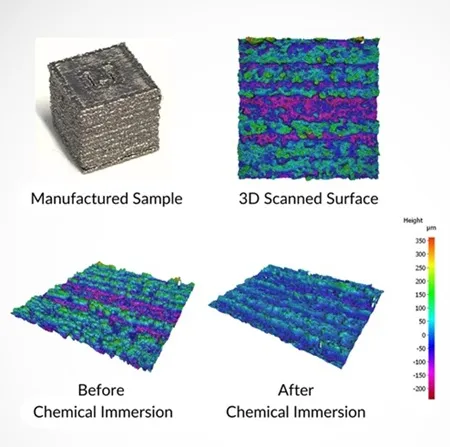
One of the principal focus areas of this project is to understand how surface roughness correlates with part performance. To investigate this, first an optical non-contact profilometer was used to assess the difference in surface roughness on a series of test samples. These include both as-built samples and samples subjected to a chemical post-processing technique involving immersion in a dilute acid solution composed of hydrofluoric acid (HF) and nitric acid (HNO₃). The figure below illustrates the change in topography between the before and after acid treatment. Preliminary results demonstrate that immersion in acid mixture leads to a measurable reduction in surface roughness; investigations are now underway to observe the subsequent effect of this topographical improvement towards wear resistance on components in contact under relative motion.
In parallel, the research team is also examining the ability of inherent surface irregularities - before and after post-processing - to act as controlled micro-reservoirs, reducing friction under lubricant-starved operating conditions.
The outcomes of the GLAM project have wide-ranging applications across sectors such aerospace, automotive, and biomedical engineering where components with complex geometries, extended fatigue life, and excellent tribological performance are essential. On a national level, this work has the potential to reduce reliance on imported components, lower production costs, and promote more agile and sustainable locally customised manufacturing.
This article explores the research being carried out by Mr Kris Bajada, Dr. Andre Giordimaina, Prof. Arif Rochman, and project lead Prof. Inġ. Glenn Cassar from the University of Malta, together with Dr. Inġ. Bonnie Attard from The Malta College of Arts, Science & Technology. The GLAM (SINO-MALTA-2022-13) project was financed by XJENZA Malta and the Ministry for Science and Technology of the People’s Republic of China (MOST), through the SINO-MALTA Fund 2022 (Science and Technology Cooperation).
Information and image source:
Attachments: External Link
Subscribe to