-
 Welcome to plumtriA platform for Research & Innovation
 -
 Looking for Funding?Check out the current open calls
 -
 Register today to start receiving our monthly newsletter
 -
 Looking to partner up?Search our list of registered profiles
 -
 You have questions on a particular funding programme?

Closed-Loop Hydrocarbon Extraction for the Valorisation of Olive Mill Waste: Principles, Technologies, and Process Integration
Image
Dr. Frederick Lia and Karen Attard
Closed-loop hydrocarbon extraction is an efficient and selective technique for recovering non-polar compounds from complex matrices, with growing relevance in olive mill waste (OMW) valorisation. Hydrocarbons, composed solely of carbon and hydrogen, range from simple alkanes to complex aromatic structures and are widely used in industrial applications due to their chemical stability [1].
Traditional separation methods such as cryogenic distillation and open solvent extraction suffer from high energy demand, solvent loss, and environmental impact [2]. Closed-loop systems overcome these limitations by operating under sealed, pressurised conditions that enable full solvent recovery. Liquefied hydrocarbons such as n-butane and n-propane selectively dissolve lipophilic compounds, while continuous recirculation enhances mass transfer and reduces emissions, aligning with green chemistry principles [3,4].
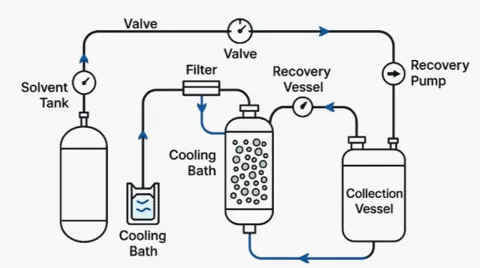
These systems consist of integrated components including a solvent tank, extraction column, collection vessel, recovery pump, and vacuum system. Under subcritical conditions, compounds such as lipids, waxes, and terpenes are extracted, and solvent removal occurs under mild thermal or vacuum conditions due to low boiling points, preserving thermolabile compounds and improving product quality [4].
Applications include petroleum recovery (e.g., VAPEX), supercritical extraction of hydrocarbons from sludges, and analytical workflows requiring containment of volatile compounds [3,5,6]. However, in OMW research, focus has largely remained on polyphenol recovery via membranes or liquid–liquid extraction [7]. The hydrocarbon-based recovery of lipophilic fractions remains underexplored despite its potential.
Key advantages include high efficiency, solvent recyclability, reduced energy consumption, and improved extract quality. Limitations include safety concerns due to flammability, reduced efficiency for heavier fractions, and challenges in scale-up [8,9].
Overall, closed-loop hydrocarbon extraction represents a promising yet underutilised approach for integrated OMW valorisation, supporting circular bioeconomy strategies through combined recovery of polar and non-polar fractions.
Funding
Funding Project ‘A Complete Sustainable Route For The Utilization Of Olive Pomance: Production Of Bioactive Spurt Inhibtors And Alternative Proteins - SustainOlive’ financed by Xjenza Malta -TÜBİTAK Joint Call for R&I Proposals, 2024 Call.
References
1. Ponce-Espinosa, H., Ponce-Cruz, P. & Molina, A., 2013. Artificial Hydrocarbon Networks. In: Artificial Organic Networks: Artificial Intelligence Based on Carbon Networks. Studies in Computational Intelligence, Vol. 521. Springer, pp. 73–111. DOI: 10.1007/978-3-642-37844- 1_4
2. Yang, L., Qian, S., Wang, X., Cui, X., Chen, B. & Xing, H., 2020. Energy-efficient separation alternatives: metal–organic frameworks and membranes for hydrocarbon separation. Chemical Society Reviews, 49(15), pp.5359–5406. https://doi.org/10.1039/D0CS00289A
3. Butler, R.M. & Mokrys, I.J., 1998. Closed-loop extraction method for the recovery of heavy oils and bitumens underlain by aquifers: The VAPEX process. Journal of Canadian Petroleum Technology, 37(4). DOI: 10.2118/98-04-04
4. Wu, Y., Wei, S. & Xi, J., 2025. Liquefied petroleum gas extraction: an innovative, green, and sustainable approach for extracting natural lipophilic compounds. Comprehensive Reviews in Food Science and Food Safety, 24(9), e70258. https://doi.org/10.1111/1541-4337.70258
5. Ávila-Chávez, M.A., Eustaquio-Rincón, R., Reza, J. & Trejo, A., 2007. Extraction of hydrocarbons from crude oil tank bottom sludges using supercritical ethane. Energy Sources, Part A: Recovery, Utilization, and Environmental Effects, 29(23), pp.2327–2345. DOI: 10.1080/01496390701446449
6. Lucke, R.B., Campbell, J.A., Ross, G.A., Goheen, S.C. & Hoppe, E.W., 1993. Closed-system, solid-phase extraction cleanup method for removal of normal paraffin hydrocarbon from samples prior to purge-and-trap volatile analysis. Analytical Chemistry, 65(17), pp.2420– 2424. DOI: 10.1021/ac00065a024
7. Tapia-Quirós, P., Montenegro-Landívar, M.F., Reig, M., Vecino, X., Saurina, J., Granados, M. and Cortina, J.L., 2022. Integration of membrane processes for the recovery and separation of polyphenols from winery and olive mill wastes using green solvent-based processing. Journal of Environmental Management, 307, 114555. https://doi.org/10.1016/j.jenvman.2022.114555
8. Monin, J.C., Barth, D., Perrut, M., Espitalié, M. & Durand, B., 1988. Extraction of hydrocarbons from sedimentary rocks by supercritical carbon dioxide. Organic Geochemistry, 13(4–6), pp.1079–1086. DOI: 10.1016/0146-6380(88)90292-6
9. Song, Y., Furtos, A., Fuoco, D., Boumghar, Y. & Patience, G.S., 2022. Meta-analysis and review of cannabinoids extraction and purification techniques. The Canadian Journal of Chemical Engineering, 101(6), pp.3108–3131. https://doi.org/10.1002/cjce.24786
Attachments: