-
 Welcome to plumtriA platform for Research & Innovation
 -
 Looking for Funding?Check out the current open calls
 -
 Register today to start receiving our monthly newsletter
 -
 Looking to partner up?Search our list of registered profiles
 -
 You have questions on a particular funding programme?

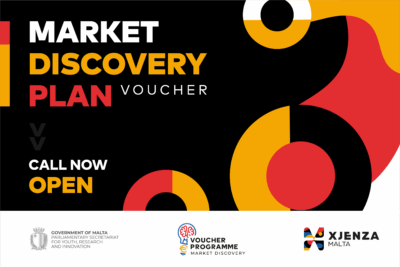
The Market Discovery Plan Voucher is designed to help innovators strategically position their technology for investment and market entry. It supports FUSION beneficiaries who have reached Technology Readiness Level 5 or higher and already have a well-developed business plan.
Through this programme, beneficiaries receive expert guidance on:
- Identifying the most effective opportunities to present their innovation.
- Targeting the right investor profiles and funding sources.
- Selecting high-impact platforms and events for exposure.
- Crafting a strong, investor-ready communication strategy.
Working closely with a pre-approved Xjenza Malta service provider, participants will develop an action plan to secure investment via investor events, direct outreach to angel investors or venture capitalists, and consultation with experienced fundraising advisors. Support also covers the creation of tailored investor presentations that highlight competitive advantage, financial potential, and exit strategies.
Visit the below link to read further and download application forms and guidelines.
Call Deadline:
The Voucher Programme will close once all funds have been allocated. Additionally, the programme will temporarily close during the following periods:
- 30 June to 31 August
- 1 December to 9 January
Information and image source:
Organisation:
Xjenza Malta
Call Deadline:
Saturday, January 31, 2026
Further Information:
External Link
Image
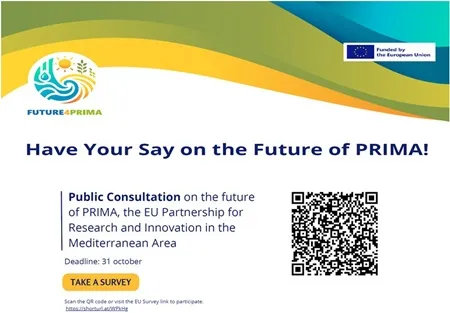
A Public Consultation is being launched on the future PRIMA Partnership (PRIMA 2). The consultation is live and will remain open until 31 October 2025. It is aimed at research centres and academia, private sector, practitioners, farmer associations, agro-food and water actors, and research and policy contacts who are central to ensuring the uptake and sustainability of results.
PRIMA (Partnership for Research and Innovation in the Mediterranean Area) is currently reflecting on its future. With the support of the Horizon Europe project FUTURE4PRIMA, preparations are underway for a possible new phase — PRIMA 2. Since 2018, PRIMA has mobilised nearly €600 million, funding over 260 cross-border projects in water, farming, food, and ecosystems.
It has created 127 demonstration sites, generated more than 170 exploitable results, and contributed to science diplomacy and trust-building across the region. At the same time, interim evaluations by the European Commission (1st in 2022 and the 2nd ongoing, to be concluded in December 2025) have highlighted persistent systemic gaps: many results remain confined to pilots, uptake across borders is uneven, procedures are fragmented, and Southern Mediterranean actors still have limited leadership roles. PRIMA 2 is conceived to consolidate what has worked while addressing these gaps.
Your views will directly feed into the Joint Programme proposal for PRIMA 2 and the European Commission’s Impact Assessment, ahead of decisions under the next EU Framework Programme (FP10, 2028–2034).
This consultation is a crucial step in shaping PRIMA 2. It seeks input from stakeholders across the Mediterranean on priorities, barriers to innovation, governance options, and ways to ensure adoption and impact.
The results will directly feed into the Joint Programme proposal and the European Commission’s Impact Assessment.
Thank you very much for your commitment and contribution.
Participation deadline: 31 October 2025
Information and image source:
Attachments:
Image
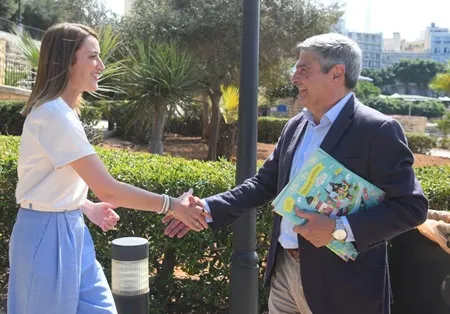
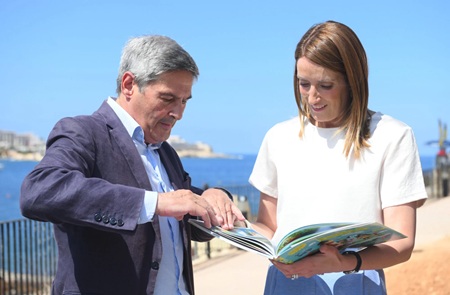
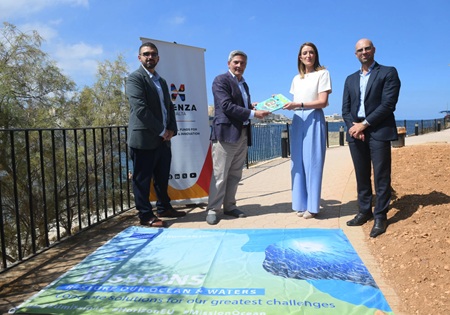
The President of the European Parliament, Roberta Metsola, met our BlueMissionMed partners XjenzaMalta, for the presentation of “Our Blue Treasure“, the ocean and waters literacy educational book developed for young audiences by our project’s partners FVA – New Media Research.
The ad hoc meeting was a pivotal moment to underline the vital role of early education in shaping environmentally conscious citizens and supporting the broader objectives of the EU Mission “Restore our Ocean and Waters by 2023”.
The discussion also provided an opportunity to present the progress and outcomes of BlueMissionMed, which brings together stakeholders across the Mediterranean to co-create sustainable solutions for the protection and restoration of marine and water ecosystems.
President Metsola’s support on our book for kids represents a strong political recognition of the role of education and citizen engagement in advancing Mission Ocean goals.
This Project will also be present at Science In the City event, being held between 26 - 27 September 2025.
Information and image source:
Attachments:
ASTROBEAT proposes for the first time the investigation of the cold-welding phenomenon for use in spacecraft hull repair following a hypervelocity impact by space debris. An experimental test rig will be tested and qualified, at TRL 6, on the International Space Station, thanks to an environment providing for an extended period of time micro-gravity conditions.
The project is led by Dr Leonardo Barilaro, Senior Lecturer in Aerospace Engineering a MCAST – The Malta College of Arts, Science and Technology.
It has been shown that similar metallic materials can fuse or weld at ambient temperatures provided that there are sufficiently high contact forces. In the Space environment, this fusion is aided by the fact that the joint surfaces do not re-oxide after wear and, as a consequence, atomic diffusion of the metal occurs at lower contact forces. Cold-welding in the Space environment was first analyzed in the 1960s as an adverse reaction from wear and it was attributed to be the cause of failure of certain mechanisms. This research, however, will investigate the potential of cold-welding for use in spacecraft hull perforation repair.
Spacecraft shield and hull perforation may occur after a hypervelocity impact due to micrometeoroids or space debris. In-situ repair from inside the vehicle is preferable due to the pressure differences. Evaluating a paradigm shift in cold-welding adhesion, this project aims at developing a test apparatus to apply custom repair patches and will investigate its adhesion properties. The recovery of the payload will allow further metallurgical analysis of the cold-welded joint. After the terrestrial development and validation using a vacuum chamber (first phase), the core activity is the design and testing of the experimental setup and its integration as a payload to carry out the activity onboard the International Space Station. The test rig will be able to simulate the hull breach in terms of crack and opening and will be capable of applying the repair patch and monitoring its performance (second phase).
Dr Leonardo Barilaro is also coordinating the Space Art project that will send new music onboard the International Space Station. The main feature of this initiative is its interdisciplinary approach, utilizing music as a powerful language to transcend cultural barriers and reach diverse audiences beyond formal education systems.
The Department of Aviation at the Malta College of Arts, Science & Technology (MCAST) and the Aerospace, Mechanical and Electronic Department at South East Technological University (SETU) will collaborate with the Centre of Studies and Activities for Space (CISAS) “G. Colombo” of the University of Padova and the Skyup Academy, Italy for the second phase of this research project.
ASTROBEAT (SUP-2023-09) is a EUR 125,000 project financed by the Malta Council for Science & Technology through the Space Upstream Programme.The International Space Station payload opportunity is being made available by Nanoracks, through its Space Act Agreement with NASA’s U.S. National Lab.
Image
Information, logo and video source:
Attachments:
Subscribe to