-
 Welcome to plumtriA platform for Research & Innovation
 -
 Looking for Funding?Check out the current open calls
 -
 Register today to start receiving our monthly newsletter
 -
 Looking to partner up?Search our list of registered profiles
 -
 You have questions on a particular funding programme?

Following Malta’s recent accession to the Artemis Accords, Xjenza Malta is pleased to share an exciting opportunity from NASA for members of Malta’s research and innovation community.
NASA has launched the 7th cohort of the Spaceflight Technology, Applications, and Research (STAR-7) virtual training programme, which focuses on the science and technology behind biological experiments conducted in space.
The programme aims to encourage networking and collaboration in spaceflight technologies, applications, and research while preparing researchers to develop and conduct spaceflight experiments using NASA and commercial platforms.
The STAR-7 programme is expected to run virtually from September 2026 to February 2027, with weekly two-hour online sessions.
Eligibility
Applicants must:
• Hold an advanced degree (MD, PhD, or equivalent);
• Be a Principal Investigator (PI), Senior Research Scientist, or Postdoctoral Scholar interested in space biosciences;
• Be affiliated with a commercial entity, academic institution, international organisation, NASA Centre, or other government agency;
• If applying as a Postdoctoral Scholar, include a reference letter from their supervisor.
Key Information
• Call Number: NNH26ZDA012L
• Application Deadline: 31 July 2026, 11:59 PM Eastern Time (USA)
• Notification of Results: On or after 14 August 2026
• Programme Duration: September 2026 – February 2027 (estimated)
Applications must be submitted directly to NASA through the NSPIRES system in accordance with the official call documentation.
Continue reading by clicking the external link:
Organisation:
NASA
Application Deadline:
Friday, July 31, 2026
Email address:
hq-star-management@mail.nasa.gov
Further Information:
External Link

The vacancy notice for HR Budget & Workforce Planning Officer - F4E/TA/AD6/2026/0298 has been published on the F4E Website and is open for applications until 15/09/2026, 11.59 AM (Barcelona time):
https://fusionforenergy.europa.eu/vacancies/
Organisation:
Fusion for Energy
Application Deadline:
Tuesday, September 15, 2026
Email address:
https://f4e-jobs.gestmax.eu/help/contact?
Further Information:
External Link
Image
HEDGE-IoT Open Call 2 opens on 25th of June, 2026 and it will close on 25th of August, 2026 at 17:00 CET.
HEDGE-IoT Open Call 2 offers more than €1 million in funding (€1,050,133) to support up to 18 innovative projects across Europe. Successful applicants can receive up to €60,000 to develop, validate, and scale their solutions within the HEDGE-IoT ecosystem.
By participating, SMEs and innovators will:
- Leverage HEDGE-IoT’s distributed digital solutions.
- Prove the interoperability and scalability of their solutions.
- Contribute to advancing energy consumer services and the EU’s energy transition.
- Apply on F6S until 25 August 2026, at 17:00 CEST;
- HEDGE-IoT grants up to €60K (equity-free);
- Empower innovators to develop innovative, IoT-enabled, data-driven energy services within the HEDGE-IoT framework;
- Mentoring and connections;
- Find out more on the HEDGE-IoT site.
Information and image source:
Attachments:
Image
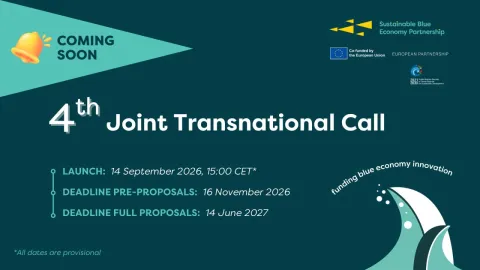
The Sustainable Blue Economy Partnership (SBEP) has preannounced its 4th Joint Transnational Call for Research and Innovation (R&I) projects in the blue economy.
💶 Funding
The call will make available close to €37 million, contributed by 35 funding organisations across 28 countries, to support transnational R&I projects that contribute to Europe's transition towards a sustainable blue economy.
Malta-based applicants are eligible to apply for funding for Research and Innovation (R&I) projects. For details, please follow Xjenza Malta website.
🌊 Priority Areas
- Transitioning blue economy sectors for sustainability and strategic autonomy;
- Managing sea uses through digital and ecosystem-based approaches;
- Promoting sustainable blue bioresources;
- Building resilience in coastal communities.
📅 Provisional Timeline
- Call launch: 14 September 2026
- Pre-proposal deadline: 16 November 2026
- Full proposal deadline: 14 June 2027
🤝 Partner Search
The SBEP Partner Search Tool is already available to help applicants identify project partners and prepare competitive proposals ahead of the official launch."
Information and image source:
Attachments:

EIT Culture & Creativity has just opened EUR 600,000 in funding for organisations ready to develop practical training for Europe's audiovisual media sector 🎬
The sector is changing fast - AI is reshaping production workflows, platforms are rewriting the rules on rights, and storytelling is expanding into entirely new formats. This call funds the organisations best placed to help professionals keep up.
With up to EUR 75,000 per project, the call supports the design and delivery of short, practical CPD courses across three thematic areas:
⚖️ Intellectual Property, Rights & Content Exploitation
🤖 Artificial Intelligence in Audiovisual Production & Workflows
🎭 Storytelling for Digital, Interactive and Cross-Media Environments
Open to education providers, industry organisations, research institutions and media bodies in EU Member States and Horizon Europe associated countries.
📅 Applications close 14 Sept 2026, 17:00 CET
Information and image source:
Organisation:
EIT Culture & Creativity
Application Deadline:
Monday, September 14, 2026
Email address:
communications@eit-culture-creativity.eu
Further Information:
External Link
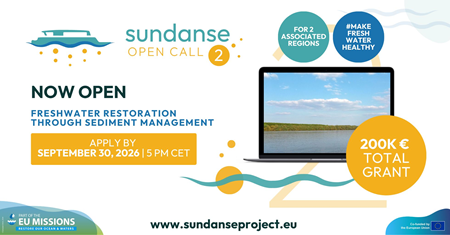
[European Union, July, 2026]: As Europe intensifies efforts to safeguard its critical freshwater infrastructure, the EU-funded SUNDANSE project has officially launched its second Open Call. This funding mechanism delivers a total of €200,000 to help forward-thinking communities transition from planning to real on-the-ground action.
The core objective of the call is to address the hidden environmental threats resting beneath the surface of European waterways: sediment dynamics and water flow management. Sub-surface imbalances, pollution accumulation, and altered flow regimes directly threaten water security, biodiversity, and regional climate resilience. This funding call offers a direct route for local public authorities to implement advanced, practical solutions to reverse these trends.
The call will select two Associated Regions from 31 eligible European and Associated countries, providing each successful applicant with a direct grant of up to €100,000 alongside technical and scientific support from the SUNDANSE consortium.
Eligible local and regional authorities established in participating nations - Albania, Armenia, Bosnia and Herzegovina, Croatia, Cyprus, Czechia, Denmark, Finland, Germany, Greece, Hungary, Iceland, Italy, Kosovo, Latvia, Lithuania, Luxembourg, Malta, Moldova, Montenegro, Netherlands, North Macedonia, Norway, Poland, Portugal, Slovakia, Slovenia, Spain, Sweden, Türkiye, and the United Kingdom - are encouraged to leverage this opportunity to deploy water flow monitoring tools, undertake sediment quantity tracking and quality assessments to mitigate pollution, and launch localised public awareness campaigns for freshwater basin care.
"With the official launch of this second funding round, we are putting practical tools directly into the hands of regional managers," said Professor Lucian Georgescu, Coordinator of the SUNDANSE project. "By focusing on sediment management and water flow tracking, this programme empowers local authorities to make a tangible, lasting impact on the health of their freshwater ecosystems."
The application window is open until Wednesday, 30 September 2026 (5 PM CET). To support applicants, the consortium will host two informative webinars on 29 July 2026 and 16 September 2026. To read the guidelines, register for the support webinars, and apply, visit: sundanseproject.eu/sundanse-open-call-2/.
***
Call Deadline:
Wednesday, September 30, 2026
Further Information:
External Link
Image
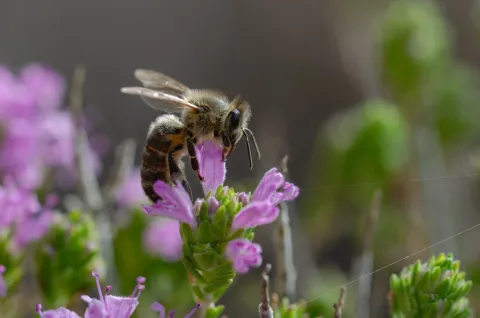
Photo credits: James Ciarlo` ©
Honey bees and other pollinators sit quietly behind much of the food we eat. By carrying pollen from flower to flower, they make it possible for most crops to set fruit. As climate change brings hotter summers, longer droughts, and an earlier, more unpredictable spring, the pressure on these small but essential workers keeps growing. Over the past years, the BeeSustain project (Integrative Modelling for Enhanced Beekeeping Carrying Capacity) set out to help Malta’s beekeepers meet that pressure with better information. Led by the University of Malta’s Biodiversity and Ecology Research Group (BERG) and funded by the Xjenza Malta Research Excellence Programme (REP) 2024, the project has now reached its conclusion, and it leaves behind a richer picture of how honey bees, other pollinators, plants, and climate fit together on the Maltese islands.
BeeSustain centred on an experimental apiary at Manikata, home to colonies of the endemic Maltese honey bee (Apis mellifera ruttneri). Earlier BERG research showed this honey bee to be especially well suited to local conditions. Around those hives, the project brought together three disciplines of science that rarely meet in one place: the biology of the honey bees and the flowers they visit, the mapping of the surrounding landscape, and the monitoring of local weather and climate conditions. What follows is a look at what each of those strands achieved.
Reading the landscape through the bees
One of the project’s most innovative strands was its use of DNA-based analysis to build a clearer picture of the plants which support bee colonies through the year via their nectiferous flowers and pollen. Analysing plant DNA collected from bee’s guts (that way, we were sure that the bees were feeding on the plant), allowed us to identify the main seasonal forage patterns around the
Photo credits: James Ciarlo` ©
Manikata apiary. The picture that emerged was as a broad and varied menu in spring, a summer strongly linked to Maltese wild thyme, and an autumn heavily reliant on eucalyptus and carob. Alongside this, honey samples were assessed for colour, consistency and taste, revealing very similar seasonal patterns.
Together, these findings show us that the food landscape available to honey bees changes dramatically over the year, an essential insight for understanding the carrying capacity of a landscape (or how many hives can an area sustainably support).
Mapping the best places to keep honey bees
To work out where bees are most likely to thrive, BeeSustain turned to environmental data. Using drone imagery and open satellite data, the team mapped the vegetation around the apiary and built a decision-making framework that ranks locations by how much good forage they offer. This was then used to estimate the “carrying capacity” of the Manikata area, roughly how many colonies the local flowers can sustainably feed. The result is both a practical figure and, more importantly, a repeatable method that can be applied to other sites across the islands.
Watching the weather around the hive
A weather station installed beside the hives recorded the local climate in fine detail, allowing researchers to describe the specific conditions the colony experiences and to compare them against Malta’s national weather records. This effort also opened an unexpected door: in the course of the
work, the team recovered and evaluated a set of observations from nine stations across the islands, producing the most detailed spatial picture yet of how Malta’s climate varies from place to place. This research is currently undergoing peer-review for scientific publication.
Bringing all of these threads into a single predictive tool proved more demanding than a project of this length could fully complete: the hive record so far covers only a single year, and some of the data needs further development before firm forecasts can be made. But this is the nature of pioneering work. BeeSustain has built the methods, and assembled the first purpose-collected datasets that a fully working system will be built upon.
Featured at the University of Malta Research Expo 2025 and feeding into new scientific publications, BeeSustain has laid firm groundwork for a smarter, more climate-resilient future for Maltese beekeeping. For more information, visit the BERG website and Facebook page
Information and image source:
Attachments:
Image
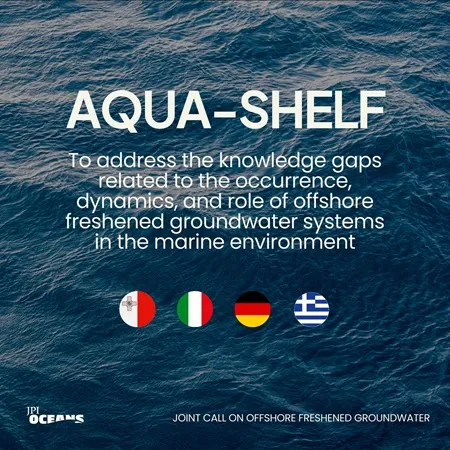
A new JPI Oceans-funded project, AQUA-SHELF, has been recommended for funding under the Joint Call on Offshore Freshened Groundwater (OFG), funded by partners from Malta, Italy, Germany and Greece.
Coordinated by Prof. Sebastiano D'Amico (University of Malta), the project will carry out one of the first dedicated scientific drilling and hydrogeological validation campaigns for OFG in a European continental shelf setting at a site in the northern Adriatic Sea. The research will combine offshore drilling, field measurements and modelling to better understand how these subsurface freshwater systems are structured and how they function.
By addressing critical knowledge gaps, AQUA-SHELF will strengthen the scientific basis needed to assess sustainability and inform decision making on the management of coastal and offshore water resources. Its findings are expected to contribute to future policy development in this field of emerging attention.
Xjenza Malta, Ministero dell'Università e della Ricerca, Italy, Regione Autonoma Friuli Venezia Giulia, Italy, Bundesministerium für Bildung und Forschung, Germany, and the Hellenic Centre for Marine Research, Greece with in-kind contributions. The Joint Call is co-branded by the UN Ocean Decade.
Attachments:

Xjenza Malta is inviting international and local experts to support research excellence by joining its growing pool of evaluators. Contribute your expertise, gain recognition, and help shape the future of research and innovation in Malta.
Organisation:
Xjenza Malta
Email address:
info.xjenzamalta@gov.mt
Further Information:
External Link
Image

Xjenza Malta is inviting international and local experts to support research excellence by joining its growing pool of evaluators. Contribute your expertise, gain recognition, and help shape the future of research and innovation in Malta.
Continue reading following the link below.
Attachments: Subscribe to