-
 Welcome to plumtriA platform for Research & Innovation
 -
 Looking for Funding?Check out the current open calls
 -
 Register today to start receiving our monthly newsletter
 -
 Looking to partner up?Search our list of registered profiles
 -
 You have questions on a particular funding programme?

Image
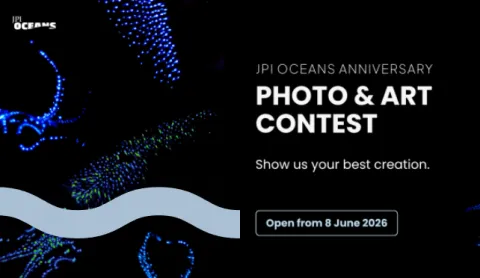
🎉To mark its 15th anniversary, JPI Oceans is launching a photo and art competition inviting artists, photographers, and enthusiasts to illustrate the science behind our Joint Actions.
🏆Awards
The winner will be awarded with a prize of €1,000, and each of the two runners-up will receive €500.
Winning works will be showcased at the JPI Oceans office in Brussels, and promoted across our communication channels and events throughout the anniversary year. In addition, we are exploring ways to exhibit them in a policy space in Brussels.
🗓️Timeline
- Competition opens: 8 June 2026, World Oceans Day
- Submission deadline: 6 September 2026
- Winners announced: October 2026
Continue reading using the below link.
Information and image source:
Attachments:
Xjenza Malta together with the EIT - European Institute of Innovation and Technology EIT have launched the EIT Regional Innovation Booster.
This programme is designed to support high-potential Maltese Start-Ups and SMEs with market-ready solutions, helping them to expand internationally and accelerate their growth with financial support of up to €90,000 throughout the programme stages. Selected participants will have the opportunity to get expert guidance from European innovation leaders.
Information and image source:
Call Deadline:
Wednesday, July 15, 2026
Further Information:
External Link
Image
Xjenza Malta together with the EIT - European Institute of Innovation and Technology EIT have launched the EIT Regional Innovation Booster.
This programme is designed to support high-potential Maltese Start-Ups and SMEs with market-ready solutions, helping them to expand internationally and accelerate their growth with financial support of up to €90,000 throughout the programme stages. Selected participants will have the opportunity to get expert guidance from European innovation leaders.
For more information visit the Xjenza Malta website:
Information and image source:
Attachments:

📣 Malta-based entities can still join BrainHealth 2026 projects
The BrainHealth 2026 Joint Transnational Calls have reached the full proposal stage, and Malta-based organisations can still participate by joining existing projects.
💰 Up to €500,000 funding available
🔎 Find a consortium or showcase your expertise
Browse or share your expertise via the partner search tool:
https://partfinder.ncbr.gov.pl/ (filter: BrainHealth Call 1/2)
📅 Submission Deadline: 30 June 2026
➡️ More Information: Visit Xjenza Malta’s BrainHealth webpage: Click here!
Information and image source:
Call Deadline:
Tuesday, June 30, 2026
Further Information:
External Link
Image

Elenya Spiteri scoops €10,000 top prize at EU award.
A Maltese medical technology entrepreneur has won a top EU award after inventing a device inspired by her great-grandmother's struggle to manage her medication.
Elenya Spiteri, 20, won the AmCham EU Youth Entrepreneurship Award 2026 with her ‘Medilert’ automated medicine dispenser, beating two other finalists from Albania and Latvia.
The award comes with a €10,000 cash prize and a year of mentoring.
Spiteri’s invention combines an automated dispenser with app-based monitoring and voice reminders, aimed at improving patient care for elderly patients.
“The idea started out in my great-grandparents’ living room," Spiteri said. "I saw my great-grandmother struggle with her medications, and I saw the constant worry and stress it put on my family when she forgot to take her medication or took double the dose.”
“Medilert is that ‘living room moment’. I took that idea and built a company out of it,” she said, adding that she started the company last year before entering her invention into competitions around Europe.
Describing the win as “surreal” and a “moment of pride”, Spiteri said the award would help build Medilert’s credibility and support the scaling up of its operations.
'Dream to have my own company'
The Saint Martin's Institute of Higher Education student said her long-term plan for the company was to expand into other European markets and work on Medilert full-time.
“It has always been my dream to have my own company; working on the company doesn’t feel like a job to me, but rather a mission. I also plan to keep studying, as knowledge is always the door to achieving your dreams.”
The AmCham award, now in its 14th year, was created by the American Chamber of Commerce to the European Union. Since 2021, it has focused on start-ups with female founders, co-founders or lead team members.
Spiteri was declared competition winner after delivering a presentation about her company and facing a grilling from a panel of senior business leaders, policymakers and EU-US representatives.
'Strong example of a young woman entrepeneur'
She received the award at this year’s AmCham EU Annual Gala, which featured the participation of European Commissioner Glenn Micallef’s cabinet, EU Commissioner Maria Luís Albuquerque and senior members of the US mission to the EU.
AmCham EU CEO Malte Lohan called Medilert a “strong example of how young women entrepreneurs are bringing fresh thinking to Europe’s economy”.
“Elenya has shown what is possible when a clear business idea is matched with the determination to bring it to market. We are pleased to recognise her achievement and the example she sets for women entrepreneurs across Europe.”
Other finalists included Albanian entrepreneur Bora Selenica, who was recognised for her ‘Pigi’ financial education app aimed at children aged five to 14, and Latvian entry Marija Ručevska for her early-stage venture capital fund investing in pre-seed and seed tech companies across Baltic and Nordic states.
The competition was held in collaboration with JA Europe, a leading European organisation providing teaching, volunteering and mentoring experiences.
Information and image source
Attachments:
Xjenza Malta is pleased to announce the opening of the Fourth Malta PECS Call under the European Space Agency’s (ESA) Plan for European Cooperating States (PECS). This call provides opportunities for companies and organisations based in Malta to submit proposals for a variety of space-related research and development activities. The call are opens on the 1st of June 2026 and will remain open till the 30th of June 2026 at 13:00hrs CET.
Visit the below link to view call specifications, access guidelines and application links.
Information and image source:
Organisation:
European Space Agency’s (ESA) Plan for European Cooperating States (PECS) and Xjenza Malta
Call Deadline:
Tuesday, June 30, 2026
Further Information:
External Link
Image

PREMIERTOGO tackles this problem head-on. Prof. Ing. Philip Farrugia leads the project, treating the lower-limb prosthesis as a system that can be designed, monitored, and adapted for each person. ‘Most existing prosthetics are still largely passive. They don’t capture what’s happening during use, nor do they adapt to it. We wanted to change that baseline,’ says Mr Adrian Mercieca, who works as an RSO on the project.
This ambition shapes every part of the project, from the cover to the knee, ankle, foot, and the sensors inside. The result is more than just one improvement. It is a new way to think about prosthetic design. The most obvious change is the fully 3D-printed cover, which is not just for looks. It shows how 3D printing can make prosthetics better and easier to produce.
Form Follows Force
The team started by looking at the old design. The previous cover was bulky, complicated, and hard to put together. It used standard fasteners, offered little room for personalisation, and had too many parts. The redesign aimed to use fewer parts, make assembly easier, cut weight, and improve its appearance without weakening it.
The cover was designed for 3D printing from the start, rather than being adapted later. That decision matters. Additive manufacturing rewards different shapes, connections, and internal features. ‘If you design for 3D printing from the start, you stop thinking in terms of traditional constraints,’ Mercieca explains. ‘You can simplify structure, reduce components, and integrate features directly into the geometry.’
Two main ideas shaped the cover: modularity and generative design. The modular system breaks the cover into separate parts, including interchangeable front panels. Users can change how it looks without touching the main structure. In a field focused on function, that offers something rare: choice.
Generative design provides the engineering logic. Instead of solid surfaces, the structure uses algorithm-driven patterns. Material goes where it is needed and is removed where it is not. The goal is not decoration. It is efficiency. ‘We’re not removing material for the sake of it,’ Mercieca says. ‘We’re placing it precisely where it needs to be.’
The design then moved into parametric CAD. Parts were shaped for efficient printing. Snap-fit connections replaced bolts and glue, making assembly faster and maintenance simpler. The cover was also aligned with the existing prosthetic system, avoiding a full redesign.
From there, the design was refined step by step. Wall thickness, pattern density, and connection points were adjusted to balance strength, flexibility, and manufacturability. Generative features were used only where they made structural sense. The final cover is lighter, easier to assemble, and visually distinct, without added complexity.
Material choice followed the same logic. The design was optimised for widely available printers such as PRUSA and Ultimaker. ‘There’s no value in a design that can’t be produced reliably. We had to make sure it works with real-world equipment,’ Mercieca notes.
Continue reading this article by clicking on the below link.
The PREMIERTOGO project was funded by Xjenza Malta’s MCST FUSION R&I – Research Excellence Programme (R&I-2024-013L).
Information and image source:
Attachments:
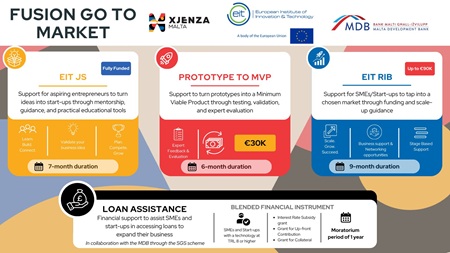
- Xjenza Malta collaborated with the European Institute of Innovation and Technology (EIT) to introduce a dedicated Maltese category within the 2026 EIT Jumpstarter Call, creating new opportunities for local idea holders and start-ups to participate in one of Europe’s leading pre-accelerator initiatives. The programme supports early-stage innovators in transforming innovative ideas into viable business concepts through hands-on training, mentorship, and exposure to cross-border networks. By providing tailored support and practical guidance, the EIT Jumpstarter programme helps participants refine their ideas, strengthen their entrepreneurial capabilities, and broader their horizons towards commercialisation.
- The Prototype to Minimum Viable Product (P2M) Programme is designed to assist start-ups and SMEs in advancing prototypes towards market-ready minimum viable products. The programme provides financial and market support to help beneficiaries refine their technologies, test market feasibility, and strengthen product development processes. Through a number of small grants, P2M supports concept validation and market entry on the basis of productivity, achievement of KPIs and promising results. At the end of the programme, beneficiaries will be allowed to pitch their final product.
- The EIT Regional Innovation Booster (EIT RIB) Malta Edition is a flagship initiative launched through a collaboration between Xjenza Malta and the European Institute of Innovation and Technology (EIT) to support high-potential Maltese start-ups and SMEs with market-ready solutions. Targeting ventures with a Technology Readiness Level (TRL) of 7 or higher, the programme provides a structured pathway for businesses seeking to expand beyond local markets and strengthen their commercial growth potential. Through access to international expertise, tailored support from an EIT RIB Buddy, investor exposure, and financial assistance of up to €90,000, beneficiaries are guided through three structured stages focused on market readiness, commercial execution, and international exposure. The programme also facilitates access to European innovation ecosystems, strategic partners, and new market opportunities, supporting Maltese innovators in scaling across selected European markets and strengthening their internationalisation efforts.
- The Go To Market Loan Assistance Programme (GTM LA) is a blended finance initiative developed through a collaboration between Xjenza Malta and the Malta Development Bank (MDB) to support innovative SMEs and start-ups approaching market deployment. Operating under the MDB’s SME Guarantee Scheme (SGS), the programme helps enterprises address key financial barriers often faced during commercialisation, including limited collateral, high financing costs, and restricted access to credit. Through a combination of interest rate subsidies, support for up-front contribution requirements, and collateral assistance, the programme facilitates access to finance for innovators with technologies at advanced Technology Readiness Levels (TRLs). By easing financial pressures linked to market entry and scale-up activities, the GTM LA programme strengthens the transition from research and development towards sustainable commercial activity within the local and European innovation ecosystem.
Please visit the above links to view application deadline.
An information session for the EIT Regional Innovation Booster (EIT RIB) Malta Edition will be held online on 15 June 2026. If you are interested in attending, you may register here: https://lnkd.in/dNnnGmQR.
For more information on the Go To Market Programme, you may contact Ms. Mariah Vella on mariah.vella.5@gov.mt or Mr. Kyle Bonnici on kyle.bonnici.4@gov.mt
Information and image source:
Organisation:
Xjenza Malta
Call Deadline:
Wednesday, September 30, 2026
Further Information:
External Link
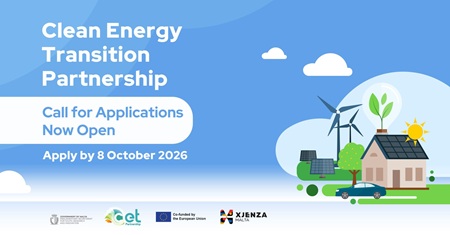
The Clean Energy Transition Partnership (CETPartnership) is a multilateral and strategic Horizon Europe partnership with the aim of driving the energy transition and contributing to the EU’s goal of becoming the first climate-neutral continent by 2050. It brings together funding from 50 programme owners across 30 countries, supporting a broad range of technologies and systems necessary for this energy transition.
The 2026 CETPartnership Joint Call is a 2-stage call structured around the following Call Modules:
- Integrated energy system resilience in a changing environment
- Energy system flexibility in a high renewable energy sources (RES) scenario: energy generation, storage and system integration
- Advanced renewable energy technologies for power production (Research-Oriented Approach)
- Advanced renewable energy technologies for power production (Innovation-Oriented Approach)
- Industrial Carbon Management
- Hydrogen and renewable fuels
- Stationary battery technologies and systems for climate-neutral industry and built environment
- Heating and cooling technologies
- Integrated regional energy systems
- Integrated industrial energy systems
- Clean energy integration in the built environment
The call modules describe specific topics and/or challenges that applicants shall address in their project proposal. Applicants must choose and apply under a specific call module when submitting their project proposal. Evaluation and ranking of the project proposals will be performed separately per call module.
Entities in Malta are eligible for funding in all call modules, with the option of requesting up to €500,000 to participate in CETPartnership proposal consortia. It is to be noted that if more than one national partner is present in one consortium, the total amount of funding for the participating national partners cannot exceed the €500,000 cap.
Visit the below link to download application forms and guidelines.
A national information session will be held online on the 19 June 2026 (10:00-11:00), please register HERE. A video recording of the session, as well as the presentation slides, will be available following the event.
For further information please contact the programme officers Ms Margherita Muscat at margherita.muscat.1@gov.mt, (+356) 2360 2339 and/or Ms. Christy Baldacchino at christy.baldacchino.2@gov.mt, (+356) 2360 2158.
Information and image source:
Organisation:
Xjenza Malta
Call Deadline:
Thursday, October 08, 2026
Further Information:
External Link
Visit the below link to view the 12 funding opportunities under Cascade Funding, an instrument by the European Commission.
Please note that these calls have different deadlines within the month of June 2026.
Information and image source:
Call Deadline:
Tuesday, June 30, 2026
Further Information:
External Link