-
 Welcome to plumtriA platform for Research & Innovation
 -
 Looking for Funding?Check out the current open calls
 -
 Register today to start receiving our monthly newsletter
 -
 Looking to partner up?Search our list of registered profiles
 -
 You have questions on a particular funding programme?

Image
TRANSCAN-4 pre‑announces the First Joint Transnational Call (JTC 2026) on the topic of:
"Translational Research on Cancer Metabolism: Multidisciplinary Approaches for Diagnosis and Treatment"
TRANSCAN-4, in continuity of the preceding ERA-NET TRANSCAN-3, has the goal of coordinating national and regional funding programmes for research in the area of translational cancer research. The specific challenge is to promote a transnational collaborative approach between scientific teams in demanding areas of translational cancer research to ensure a more efficient use of available resources (e.g. data, infrastructures) and ultimately to produce results of higher quality and impact.
🧮The TRANSCAN-4 JTC-2026 will be implemented through a two-stage submission procedure: pre-proposals and full proposals.
📢The call is planned to be formally launched on 20 May 2026
⌛Submission deadline for pre-proposals in 21 July 2026.
🏁It is expected that consortia invited to the full-proposal stage will be asked to submit their proposal in 13 January 2027.
Xjenza Malta is one of the TRANSCAN-4 funding organisations participating in the JTC-2026.
Information and image source:
Attachments:
Image
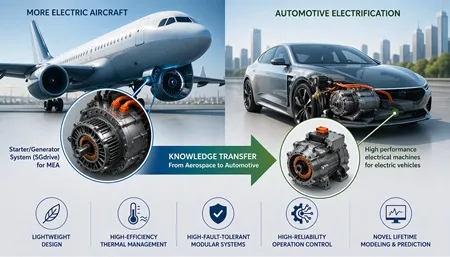
In January 2024, the Department of Electrical Engineering of the University of Malta, started work on the project SGdrive, funded by Xjenza Malta. The project’s full title is High Reliability and High Power Density Starter/Generator System for MEA (SGdrive) and is headed by Prof Inġ Michael Galea. The project aimed to address technical challenges in designing starter-generator systems for More Electric Aircraft (MEA). Key technical achievements include lightweight design, high-efficiency thermal management, modular high-fault-tolerant systems, and high-reliability operation control strategies. The University of Malta's focus lies in novel lifetime modeling and prediction techniques, contributing to advancements in aviation electrification technologies.
Beyond its technical achievements, the SGdrive project has also delivered an important and perhaps less visible impact: the transfer of knowledge across industries. Although the project focused on electrical machine design for aerospace applications, many of the insights gained have proven highly relevant to other sectors, most notably automotive electrification.
Engineers and researchers involved in SGdrive were able to apply lessons learned from designing high-performance starter-generator systems for aircraft to the development of electrical machines for automotive use. Challenges such as achieving high power density, managing heat effectively, and ensuring long-term reliability under demanding conditions are shared across both fields. By leveraging advanced modelling techniques and reliability-focused design approaches developed at the University of Malta, the team was able to inform and improve the design of an automotive electrical machine, as later presented in a peer-review publication (DOI 10.1109/ICEM60801.2024.10700291).
This cross-sector knowledge transfer highlights how innovation in one field can accelerate progress in another. In particular, it shows how cutting-edge aerospace research can contribute to the advancement of cleaner and more efficient road transport technologies. The SGdrive project therefore not only advances the state of the art in aviation systems, but also supports broader efforts towards electrification and sustainability in the automotive industry.
For more information, please contact the principal investigator Prof Inġ M. Galea on michael.d.galea@um.edu.mt or the Department of Electrical Engineering on ele.eng@um.edu.mt.
Attachments:
Image
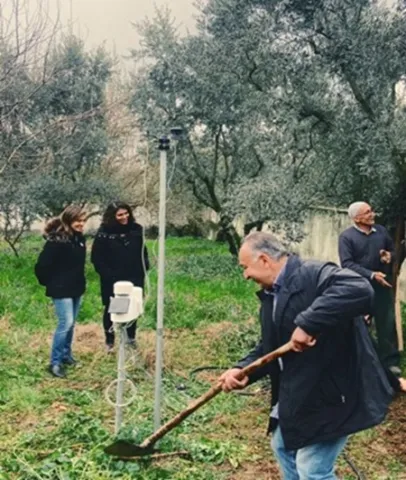
For centuries, olive cultivation has been rooted in tradition. Today, however, climate change is disrupting this balance, with heatwaves and water scarcity threatening both yield and quality. In response, the SOLEATECH project - developed by WES TRADE LTD (Malta) and Bahçeşehir University (Türkiye) under the bilateral call PRIMA Xjenza Malta- TÜBİTAK 2023 - is introducing a new paradigm: data-driven olive farming.
The first phase of the project focused on establishing a “Digital Twin” of olive orchards through the deployment of advanced IoT infrastructure. Using the IRRIGOPTIMAL platform, solar-powered Smart Nodes equipped with soil moisture, nutrient, and weather sensors were installed across pilot sites in Malta and Türkiye. This system enabled continuous, real-time monitoring of hyper-local environmental conditions.
A key scientific breakthrough emerged from this phase: the identification of the “Microclimate Gap.” Data analysis showed that regional weather models can overestimate orchard temperatures up to 8°C. This discrepancy can lead to inefficient irrigation decisions and unnecessary stress on crops.
By validating the importance of localized data, SOLEATECH demonstrated that precision agriculture must rely on field-level intelligence rather than generalized forecasts. This foundational phase sets the stage for advanced analytics and AI-driven decision-making in modern olive farming.
Information and image source:
Attachments:
The Horizon project JARVIS has just launched its Open Call 2 to support innovators developing advanced human-robot interaction solutions. This initiative offers funding and support for startups, SMEs, research organisations, industry actors, and public organisations to develop, test, and validate new technologies within the JARVIS ecosystem.
- Apply via F6S:
- Track 1, Co-Development: Apply here until 1 June 2026, 17:00 CET
Track 2, External Pilots: Apply here until 10 July 2026, 17:00 CET
- Track 1 Co-Development: For 2 tech organisations (startups/SMEs) developing new modular HRI technologies and collaborative robotics components within the JARVIS framework. Up to €100,000 per project.
Track 2 External Pilots: For 2-3 partner consortia testing JARVIS technologies in real use cases. Consortia should include a technology developer/integrator and a use-case provider, with an optional third technical partner. Up to €130,000 per project.
Information and image source:
Organisation:
Jarvis
Application Deadline:
Wednesday, July 01, 2026
Email address:
alba@f6s.com
Further Information:
External Link

The Matsumae International Foundation (MIF) is offering a prestigious, fully funded research fellowship for non-Japanese researchers. This opportunity allows post-doctoral researchers to conduct research at a Japanese host institution in any field, with preference being however given to research proposals in the fields of natural sciences, engineering, medicine and agriculture. Successful applicants will have the opportunity to carry out research in Japan for a maximum of six months anytime in the period between June 2027 and March 2028.
Eligibility Criteria
Non-Japanese nationality and alignment with MIF’s core values
Ph.D. (Doctorate) holder at the time of application
45 years old or younger (born in or after 1981)
Secured acceptance from a host institution in Japan before applying
Proficient in either English or Japanese
No prior long-term stays in Japan (except for short-term visits like conferences or tourism)
Currently employed in the home country and committed to returning after the fellowship
Fellowship Benefits
Monthly Allowance: JPY 220,000 for research and living expenses
Arrival Fund: JPY 120,000 for initial costs
Round-Trip Airfare: Economy class from home country to Japan
Insurance: Comprehensive overseas travel insurance
Study Tour: Cultural and academic enrichment program in Japan
How to Apply
Applications must be submitted via email to application@mif-japan.org.
Application Period: 1st – 30th June 2026 (Japan Standard Time)
Late or incomplete applications will not be considered.
Information and image source:
Organisation:
Matsumae International Foundation (MIF)
Application Deadline:
Tuesday, June 30, 2026
Email address:
application@mif-japan.org
Further Information:
External Link
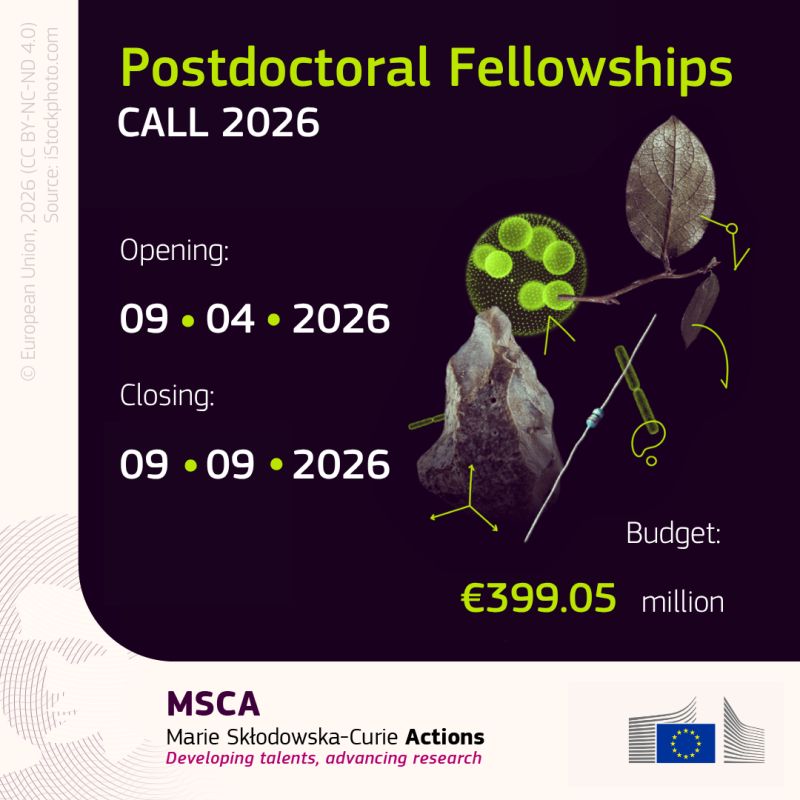
With a budget of €399.05 million, the European Commission will support nearly 1,600 researchers to acquire new skills, develop their careers, and gain international, interdisciplinary and inter-sectoral experience by working in another country.
There are two types of fellowships:
🔵 European Fellowships – open to researchers of any nationality to carry out a personalised project in the EU or countries associated to Horizon Europe for up to 24 months
🔵 Global Fellowships – open to EU and Horizon Europe associated countries nationals or long-term residents wishing to work with organisations in third countries for a period of 12 to 24 months, before returning to Europe for 12 months
🔗 Deadline for applications is 9 September 2026, 17:00 CEST.
In 2026, the Marie Skłodowska-Curie Actions (MSCA) marks 30 years of supporting research excellence and researcher mobility across Europe and beyond.
➡️ Join the celebrations and explore what’s next: link.europa.eu/DbH4Dy
Information and image source:
Organisation:
European Commission
Application Deadline:
Wednesday, September 09, 2026
Email address:
paula.pinho@ec.europa.eu
Further Information:
External Link
📢 Interested in launching your career in science and technology?
🎓An opportunity for graduates to gain experience in an EU agency and work at the forefront of fusion research through projects like ITER.
We’re looking for a diversity of profiles, from engineering and physics to finance, IT or communications, to join us in Barcelona, Cadarache or Garching.
Click here to apply by 12 May 2026.
You can join our webinar on 27 April to learn more about the application process and trainee experience.
Want to know more? Join our webinar on 27 April, 10:00 (CET)
Information and image source:
Organisation:
Fusion for Energy
Application Deadline:
Tuesday, May 12, 2026
Email address:
traineeships@f4e.europa.eu
Further Information:
External Link
Image
The Clean Energy Transition Partnership (CETPartnership) is announcing its fifth annual call, Joint Call 2026. The call is launched in collaboration with funding organisations and programme owners across Europe and beyond. The annual calls align national and regional funding programmes and enable transnational collaboration across the energy value chain.
The CETPartnership is an RDI programme that supports the transition towards a climate-neutral and sustainable European energy system.
General information about the application process
The Joint Call 2026 is structured into 11 Call Modules. These modules cover different thematic areas, scopes, RDI types, and Technology Readiness Levels (TRLs). More information on topics under Joint Call 2026 will be made available leading up to the Call Launch event.
The call consists of a two-stage application process. First, a submission of a pre-proposal, followed by an invitation to submit a full proposal.
Stage 1: Submission of a pre-proposal
A project consortium chooses one Call Module for the pre-proposal (scroll further to find the name of this year's Call Modules). If the pre-proposal is selected, the project consortium is invited to submit a full proposal.Stage 2: Submission of a full proposal
Only if the pre-proposal is invited to participate in Stage 2 can the applicants begin preparing a full proposal.
Funding for Joint Call 2026 is a collaboration with funding organisations and programme owners, who will fund eligible costs directly to Beneficiary Partners based in their country/region.
Applicants must therefore comply with the specific national/regional eligibility criteria and requirements, which can be found in the call text. Several funding organisations can require submission of a proposal at national/regional level.
After the selection of projects from the full proposal stage, the funding organisations are responsible for contracting and processing payments.
General information about eligibility criteria and requirements
The Joint Call includes the following eligibility criteria and requirements:
Transnational eligibility requirements, applicable for all project consortia applying to the Call.
Call Module requirements, applicable for project consortia applying to Call Modules with specific thematic requirements.
National/regional requirements, applicable for partners applying for funding from Funding Agencies in the Call.
All Project Consortium Partners are encouraged to carefully check all eligibility criteria and requirements, which will be outlined in the call text. Different Call Modules and different Funding Agencies may support different types of entities, TRLs, etc.
Upon a successful full proposal, it is important for applicants to know that payment will be provided directly through the respective funding organisation under which the partner applied. The CETPartnership Call Management Team is only responsible for coordinating and processing the applications on behalf of the funding organisations involved.
To learn more about the upcoming Joint Call 2026, please join us for the Call Launch scheduled at the end of May (date TBC).
More information about the call text, modules and requirements will follow this winter/spring.
Please be advised that the call modules are subject to change.
For further information, follow the link.
Information and image source:
Attachments:
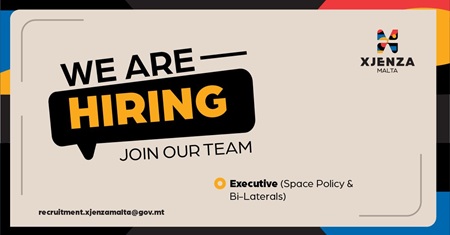
🚀 Xjenza Malta is currently seeking to recruit an Executive (Space Policy & Bi-Laterals)
Support Malta’s growing role in space governance and international cooperation.
Key focus:
• Space policy coordination
• International bilateral & multilateral engagement
• Regulatory monitoring
• Strategic partnerships with space agencies
Join us in shaping Malta’s space future.
For more information and how to apply ➡️ please click here
Information and image source:
Organisation:
Xjenza Malta
Application Deadline:
Wednesday, April 22, 2026
Email address:
recruitment.xjenzamalta@gov.mt
Further Information:
External Link
Image
The report “Gaps and uncertainties in aviation non-CO₂ effects on climate” sums up the current state of scientific understanding and highlights priority areas where further research is needed.
The impact of aviation on climate goes beyond carbon dioxide (CO₂) emissions, including non-CO₂ factors such as nitrogen oxides (NOX), sulphur oxides (SOX), water vapour, particulates, and the formation of contrails and cirrus clouds.
Developed by the Aviation Non-CO ₂ Expert Network (ANCEN), coordinated by the EASA - European Union Aviation Safety Agency and supported under Horizon Europe, the report identifies priority areas for further research.
Read the report link.europa.eu/vJgRgv
Information and image source:
Attachments: Subscribe to